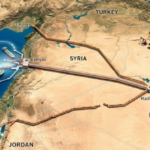
The Israeli attack on Syria’s Abu al-Duhur airbase on August 18 initially presented itself as another episode in Israel’s widening campaign to preserve military freedom of action in post-Assad Syria. Eight strikes hit the runway and storage areas of a largely inactive airfield roughly 70 kilometres from the Turkish border. No casualties were reported. Yet the political significance of Abu al-Duhur lies less in the physical damage than in what followed: the gradual transformation of an initially unattributed airstrike into an explicitly personalized Israeli warning to Recep Tayyip Erdoğan. The sequence matters because Israel did not accompany the bombs with an immediate public claim of responsibility or a detailed explanation that Turkey was the target of the warning. The Israeli military initially declined to comment; Turkey attributed the operation to Israel and condemned it; U.S. envoy Tom Barrack publicly discussed Israel’s role and called the operation an “unnecessary escalation”; and only afterward did Benjamin Netanyahu’s office publicly frame the strike as an operation to prevent an imminent Turkish military presence. Netanyahu then sharpened that message with his theatrical warning—“Don’t”—before Defence Minister Israel Katz personalized the confrontation further by accusing Erdoğan of dragging Turkey into “dangerous adventures in Syria.” What began as damage to a Syrian runway was thus transformed over roughly two days into something politically much larger: an Israeli-Turkish confrontation with Erdoğan himself placed at its centre.
Israeli actions undertaken for Israeli military reasons can create precisely the external-threat environment Erdoğan needs domestically; Erdoğan’s reaction can, in turn, reinforce Netanyahu’s portrayal of Turkey as an emerging regional danger requiring strong Israeli leadership. The underlying research reaches the same conclusion: the evidence supports a real Israeli-Turkish strategic collision whose domestic consequences may nevertheless assist Erdoğan’s nationalist and authoritarian consolidation; it does not establish deliberate Israeli support for Erdoğan’s survival.
A Military Strike Followed by a Political Construction
The Syrian account makes Israel’s subsequent explanation more complicated. Syrian Foreign Minister Asaad al-Shaibani says Damascus had already informed Israel before the attack that there was no intention to establish a permanent Turkish base at Abu al-Duhur, no plan for a permanent Turkish troop presence and no plan to transfer control of the facility to Ankara. Turkish military officers had indeed visited the base several days earlier, but al-Shaibani described those visits as part of ongoing training and military cooperation while the airfield itself was being rehabilitated for the Syrian Air Force. Reuters reported that Mossad director Roman Gofman and al-Shaibani spoke on August 14 about Turkish deployments, weapons and drones, while al-Shaibani told Axios that Syria had explained the nature of the rehabilitation work and made clear that the facility would remain Syrian. Israel may have possessed intelligence that contradicted Damascus, may have believed a temporary Turkish presence would evolve into a permanent one, or may simply have regarded any Turkish military access as unacceptable. But Netanyahu’s explanation should not be treated as an uncontested description of events. Syria says Israel was told there would be no Turkish base and bombed the facility anyway.
That distinction matters because the Israeli political explanation emerged after the attack and was explicitly about Turkey. Israel did not merely say it had destroyed Syrian weapons threatening Israel. Netanyahu’s office connected the bombing to Turkish troops; Netanyahu himself portrayed it as enforcement of a warning that Damascus had failed to understand; Katz then directed his language personally at Erdoğan. The military operation and the political narrative therefore need to be separated analytically. Israel had genuine reasons to worry that Turkish radar, aircraft, drones or air-defence systems in Syria might eventually restrict Israeli aerial freedom of action. But the increasingly personalized rhetoric transformed a military red line into an electoral and nationalist message. In Israeli politics, Netanyahu could demonstrate that he was willing to stop Erdoğan’s Turkey from moving closer to Israel. In Turkish politics, Erdoğan could present the same episode as proof that Israel was striking Syria because Turkey had become powerful enough to frighten Netanyahu. The same event therefore carries opposite narratives simultaneously: Israeli deterrence becomes Turkish evidence of geopolitical importance.
Ankara’s First Public Face Was Erdoğan’s Communications Chief
The Turkish reaction itself reinforces this interpretation. The first named senior official reaction that can be clearly verified and timestamped in the public record came not from Erdoğan, Foreign Minister Hakan Fidan or Defence Minister Yaşar Güler, but from Burhanettin Duran, Erdoğan’s Director of Communications. At 19:43 on August 18, Duran publicly condemned the Israeli strike on Abu al-Duhur and declared that, under Erdoğan’s leadership, Turkey would continue supporting Syria’s sovereignty and territorial integrity. The Foreign Ministry also issued a brief written statement dated August 18 strongly condemning Israel’s attack, describing it as another assault on Syria’s infrastructure and territorial integrity and calling for international accountability. But in the immediate public response there was no presidential address threatening retaliation, no Fidan announcement of a Turkish military red line, and no publicly announced Turkish interception.
Duran’s position is important. His formal title is Director of Communications, not “propaganda director,” and an analytical article should preserve that distinction. But politically he heads the presidential apparatus responsible for constructing, coordinating and disseminating Erdoğan’s public narrative. In that functional sense, he is much closer to the regime’s central message manager than to a conventional diplomat or defence official. The fact that the first prominent personal response came from that office is therefore striking. Ankara’s initial visible reaction was principally communicative and diplomatic rather than military: Duran supplied the presidential message, and the Foreign Ministry supplied a short institutional condemnation.
The contrast becomes sharper when Tom Barrack’s account is added. Turkey had not been warned of the operation. Turkish forces detected Israeli aircraft heading north toward Turkish territory and, Barrack said, could reasonably have prepared a military response. Yet “calm heads” prevailed, and Washington immediately began working on a stronger Israel-Turkey-Syria deconfliction mechanism. The most important point in his statement is that Ankara detected the operation, possessed military options and nevertheless avoided an openly visible confrontation.
From Palmyra and T4 to Abu al-Duhur: A Pattern of Coercion Below the Threshold of War
Abu al-Duhur was not an isolated episode. In early 2025, Turkish military teams assessed T4/Tiyas, Palmyra and facilities around Hama while Ankara considered a deeper military role in Syria following Bashar al-Assad’s fall. Israel subsequently attacked sites Turkey had examined. A Turkish visit scheduled for T4 and Palmyra on March 25 was cancelled after Israeli strikes hit the facilities only hours beforehand. Israeli officials were explicit: Defence Minister Katz characterized the operations as a warning, while Foreign Minister Gideon Saar accused Turkey of trying to establish a “Turkish protectorate” in Syria. Israel’s concern was strategically intelligible. Turkish radar, air-defence systems or combat aircraft positioned in central Syria could eventually constrain Israel’s ability to operate freely across Syrian airspace.
But what followed the 2025 strikes is as important as the strikes themselves. Hakan Fidan openly said Turkey did not want a confrontation with Israel, and the two governments developed channels intended to prevent military accidents. After Abu al-Duhur, the same pattern reappeared: attack, denunciation, rhetorical escalation, U.S. intervention and renewed deconfliction. Even amid the latest exchange of warnings, U.S. officials have stressed that they do not believe the countries are on the verge of direct war. This is why “managed antagonism” is more useful analytically than either “secret alliance” or “inevitable war.” Israel has shown that it is willing to use force against Syrian infrastructure connected to prospective Turkish activity. Turkey has shown that it will condemn those operations in increasingly dramatic language. But both governments repeatedly behave in ways intended to stop those confrontations from becoming Israeli pilots shooting at Turkish pilots or Turkish missiles killing Israeli personnel.
That history extends well beyond Syria. Erdoğan’s 2009 “One Minute” confrontation with Shimon Peres at Davos helped establish his image across the Muslim world as an unusually forceful critic of Israel. The Mavi Marmara killings in 2010 created a genuine bilateral rupture. Yet Netanyahu apologized to Erdoğan in 2013 under Barack Obama’s mediation, and Erdoğan accepted that apology while emphasizing the importance of the longstanding bilateral relationship. Relations were normalized again in 2016, deteriorated again in 2018 and were normalized once more in 2022. Gaza produced yet another dramatic rupture after October 2023, with Erdoğan attacking Netanyahu in extraordinarily harsh terms. Yet even then, trade did not stop immediately, and the discrepancy between Erdoğan’s rhetoric and continuing commerce became politically damaging enough inside Turkey that Ankara later imposed restrictions and ultimately announced a trade halt. The pattern is not evidence that the disputes were invented. It demonstrates that Erdoğan’s public rhetoric has repeatedly been more absolute than Turkish state behaviour, while Israeli governments have similarly returned to normalization whenever strategic conditions made it desirable.
The hostility is therefore not necessarily artificial; in fact, its political usefulness depends precisely on its credibility. Erdoğan benefits from an Israel that Turkish conservative and nationalist voters can plausibly regard as hostile, while Netanyahu increasingly portrays Erdoğan as a strategic adversary because of his rhetoric, ties with Hamas, Turkey’s military capabilities, and Ankara’s ambitions in Syria. This threat perception has become more pronounced as Iran and the Iran-led regional network have weakened, allowing Turkey to be increasingly portrayed in Israeli strategic discourse as a possible successor threat—effectively a “new Iran.” Interestingly, this shift began to emerge soon after Assad’s removal from power in December 2024, just as we had argued that Turkey’s expanding influence in Syria could gradually position Ankara as the principal regional adversary Israel might use to justify its broader strategic ambitions, including territorial expansion and continued U.S. military, financial, diplomatic, and political support.
Netanyahu Has Already Put Erdoğan Into His Election Campaign
The reciprocal political utility became remarkably explicit on the eve of Abu al-Duhur. One day before the strike, Likud campaign material in Tel Aviv displayed Erdoğan alongside Iran’s Supreme Leader Mojtaba Khamenei, Hezbollah leader Naim Qassem and New York Mayor Zohran Mamdani, with a message telling Israeli voters that these figures wanted Netanyahu defeated and should not be allowed to “win.” In other words, Erdoğan had already become an element of Netanyahu’s electoral language before the airbase was bombed. Israel votes on October 27, and Netanyahu approaches that election with his once-powerful security reputation damaged by the October 7 attack, Likud polling below its previous performance and significant dissatisfaction even among portions of its traditional electorate. Netanyahu therefore has a clear incentive to transform the election into a judgment not on October 7, coalition dysfunction or domestic polarization but on whether Israelis trust him to stand against regional enemies. Erdoğan fits that script perfectly.
Erdoğan can exploit precisely the mirror image of that message. Netanyahu tells Israelis that Erdoğan’s Turkey is moving into Syria and requires containment; Erdoğan can tell Turks that Israel is bombing Syria precisely because Turkey’s growing strategic weight is becoming intolerable to Israel. Netanyahu makes Erdoğan useful as an enemy; Erdoğan makes Netanyahu useful as evidence that Turkey is under pressure because of its rise. Neither government has to manufacture every element of the conflict. There are genuine disputes over Syria, Gaza, Hamas, the Eastern Mediterranean and the regional balance. Yet the political art lies in magnifying a real dispute into an existential national narrative.
Burhanettin Duran came remarkably close to admitting this mechanism—on Netanyahu’s side. Two days after the strike, he accused Netanyahu of creating “imaginary threats and enemies” because of domestic political fears and Israel’s approaching election. He characterized hostility toward Turkey as a “political lifeline” for Netanyahu. That accusation may contain considerable truth. But it becomes analytically revealing only when applied symmetrically. If portraying Turkey as a danger can function as Netanyahu’s electoral lifeline, portraying Israel as an existential threat can just as plausibly function as Erdoğan’s. Duran’s theory of Netanyahu therefore risks becoming an unintended description of Erdoğanism itself.
Erdoğan Needs the External Enemy More Than He Needs a War
The domestic circumstances make that possibility particularly important. Erdoğan enters this period not with a conventional economic collapse—headline unemployment remains relatively low—but with a prolonged and politically corrosive purchasing-power crisis. Official annual inflation stood at 31.75 percent in July; food prices were up 37.53 percent from a year earlier; housing, utilities and fuels were up more than 40 percent; consumer confidence remained below 90; and growth expectations have weakened. Years of inflation have eroded household incomes even as the government asks citizens to accept that stabilization is underway. The politically dangerous question is therefore not whether Turkey is literally in depression, but why ordinary households continue to experience such intense cost-of-living pressure after years of Erdoğan’s highly centralized economic management.
The institutional environment is even more damaging to Erdoğan’s democratic claims. Ekrem İmamoğlu, his most formidable potential presidential opponent, remains imprisoned. The CHP has faced extraordinary judicial intervention, including a court decision removing its elected national leadership. International human rights organizations describe Erdoğan’s government as having consolidated an authoritarian trajectory, while the World Justice Project ranks Turkey 118th out of 143 jurisdictions overall for rule of law, 136th for constraints on government power and 134th for fundamental rights. The government denies using the judiciary politically and insists that courts are independent, but the cumulative picture is one in which authoritarian politics increasingly takes place under conditions shaped by executive power, prosecutions and institutional intervention.
It is in this context that Abu al-Duhur becomes politically valuable. Erdoğan does not have to make citizens stop caring about food prices, rent, judicial independence or imprisoned opponents. He has to persuade enough of them that these questions are subordinate to something larger. The political criterion can be shifted from “How is Turkey governed?” to “Who can defend Turkey?” Once that substitution succeeds, purchasing-power complaints can be framed as secondary to security, judicial criticism as secondary to sovereignty, opposition conflict as dangerous division, and executive centralization as the strength required to navigate a hostile region. Erdoğan used similar techniques in 2023, when nationalist, conservative and security-centered campaigning helped displace an election that might otherwise have been dominated by economic dissatisfaction.
Abu al-Duhur is almost ideal material for that substitution because what could objectively be interpreted as Turkish strategic weakness can be rhetorically converted into evidence of strength. Israel bombed infrastructure associated with Turkey’s expanding influence, and Ankara did not visibly stop the operation. A nationalist critic could therefore ask why a government portraying Turkey as a great regional power was unable or unwilling to deter an Israeli attack so close to the Turkish frontier. Erdoğan has an obvious alternative interpretation available: Israel is attacking because Turkey has become so important that Netanyahu feels compelled to contain it. A setback becomes proof of geopolitical significance.
The Kurdish Peace Process Needs a Nationalist Story—and Israel Supplies One
The importance of that transformation becomes even greater when connected to the Kurdish peace process. Erdoğan and Devlet Bahçeli are now asking the nationalist-conservative electorate to accept a political reversal that would have seemed unimaginable only a few years ago. Parliament has adopted a framework for PKK disarmament and reintegration with support from the AKP, MHP and DEM; Bahçeli has moved from the traditional language of uncompromising hostility toward Öcalan to advocating an institutional role for him in the process; and Öcalan has become indispensable to the effort to terminate the PKK’s armed struggle. The government’s difficulty is not merely negotiating a settlement with Kurdish actors. It is explaining to nationalist voters how the man they were taught for decades to understand as the embodiment of separatist terrorism can suddenly be treated as a central political interlocutor.
The “Israel factor” can solve that ideological problem. Reported notes from Öcalan’s April 21, 2025 meeting on İmralı place Israel repeatedly at the centre of his regional analysis. These are leaked notes, not an authenticated verbatim transcript. Yet the broad political framework attributed to Öcalan is striking: Israel had allegedly encouraged Kurdish statehood for decades; Kurdish geopolitical alignment could determine the regional balance; Israel wanted Kurdish political power incorporated into a wider regional strategy; and a Turkish-Kurdish settlement would instead move strategic advantage toward Turkey. The notes even attribute to Öcalan the phrase “our country Turkey.”
The claims about Israeli strategy should not simply be accepted as fact. Historical Israeli sympathy for Kurdish self-determination—most visibly in Iraqi Kurdistan—does not prove such a comprehensive project. Nor can Öcalan, from a prison cell, sovereignly “permit” or “prevent” the establishment of a Kurdish state if a radically different regional balance were someday to produce one. His influence over the PKK and Kurdish politics is substantial; his role in ending armed struggle demonstrates that. But influence is not sovereignty. This is precisely why the political function of the claim is more interesting than its literal geopolitical plausibility.
Veysi Aktaş made this emerging narrative unusually explicit on August 20. He argued that the Kurdish question had become regional and international, warned that outside actors would intervene if Turkey failed to resolve it, and attributed to Öcalan a theory under which Israel benefits from the creation of a Kurdish nation-state. Aktaş then explicitly connected the present peace process to an “Israel factor.” As an empirical description of Israeli policy, that thesis is contestable. As a message to Turkey’s nationalist and conservative electorate, however, it is almost perfectly constructed. The Öcalan they were taught to understand as the man who wanted to divide Turkey can now be presented as the man who refused to divide Turkey for Israel.
That does not require nationalist voters to admire Öcalan or erase the history of PKK violence. Erdoğan and Bahçeli need a much smaller shift: nationalists must become willing to tolerate Öcalan’s usefulness. If Öcalan can be portrayed as having abandoned separatism, rejected an externally sponsored Kurdish state and chosen a political settlement within Turkey, cooperation with him can be repackaged not as surrender to Kurdish nationalism but as the final absorption of an armed separatist project into the Turkish state. The old nationalist equation—Öcalan → separatism → partition—can be gradually replaced by a new one: Öcalan → rejection of externally sponsored separatism → Turkish-Kurdish integration → stronger Turkey.
Duran Kalkan, Öcalan and the Politics of Rebranding
Duran Kalkan’s recent interview with Ruşen Çakır reinforces this framework. He described a changing regional order in which Israel had become an increasingly important power competing for Kurdish strategic alignment.
He also argued that Kurdish political security should ultimately be achieved through democracy in Turkey and the broader Middle East rather than through another round of nation-state warfare. Yet when Çakır asked whether Erdoğan might be manipulating the peace process for tactical purposes, Kalkan did not dismiss the possibility. His position was essentially transactional: Kurdish actors cannot know with absolute certainty that Erdoğan has no political game of his own, but they can use whatever opening exists to pursue their objectives. This is important because the process can simultaneously serve multiple agendas. Kurdish actors may seek legal recognition, political rights, prisoner releases and an end to armed conflict; Bahçeli may seek the elimination of the PKK as a military threat; Öcalan may seek political relevance and ideological vindication; and Erdoğan may seek parliamentary flexibility and a broader governing coalition. Israel, as the common external threat in the emerging discourse, can make those otherwise contradictory narratives coexist.
The political rehabilitation of Öcalan therefore deserves to be viewed as more than a side effect of demobilization. Senior Kurdish figures themselves speak as though changing how Turkish society perceives Öcalan is part of the process. The anti-Israel narrative is particularly useful in that effort because it recasts him not as someone who abandoned Kurdish interests for Ankara, but as someone who supposedly protected Kurdish interests from incorporation into another power’s regional project while simultaneously choosing coexistence within Turkey. For nationalist Turks, the same story can be inverted: Öcalan is no longer the man determined to partition the Republic, but an interlocutor whose present actions supposedly protect the Republic from externally engineered partition. One narrative can therefore be sold to two constituencies in different ways.
Kurdish Peace Can Coexist With Erdoğan’s Autocracy
This is where Erdoğan deserves the greatest criticism. Ending the PKK conflict would be historically significant and potentially beneficial to millions of Turks and Kurds. But ending an armed conflict is not synonymous with democratization. An authoritarian government can reconcile with one excluded constituency while intensifying pressure on another. It can integrate Kurdish political actors while keeping İmamoğlu imprisoned; increase Öcalan’s political relevance while weakening judicial independence; speak of Turkish-Kurdish brotherhood while courts reshape the principal opposition party; and replace military conflict with Kurdish actors without restoring media freedom, competitive institutions or meaningful constraints on presidential authority.
The result could therefore be authoritarian national consolidation rather than democratic consolidation. Erdoğan’s objective need not be opening the system equally to all competitors. It may be reconstructing the social coalition that protects his rule. A meaningful section of Kurdish politics can be incorporated or neutralized; nationalists can be reassured that reconciliation prevents foreign exploitation; conservative voters can be mobilized around opposition to Israel; the PKK can disappear as an armed threat; and the secular opposition can remain under judicial and administrative pressure. Erdoğan would stand above this new architecture as the supposedly indispensable leader who ended four decades of Kurdish conflict while defending Turkey against the foreign power alleged to be seeking its fragmentation.
The electoral mechanics make this particularly relevant. Turkey’s regular election is scheduled for May 14, 2028. Erdoğan has reached the normal two-term limit under the present presidential system, but the constitution would permit another candidacy if parliament called an early election. Such a decision requires 360 of the 600 deputies; the governing bloc does not possess that threshold alone. Support or cooperation from outside the existing alliance—including Kurdish representatives—can therefore have implications extending beyond the peace process itself. This does not prove that Erdoğan launched reconciliation solely to obtain another candidacy. It does establish powerful incentives for him to ensure that Kurdish accommodation expands his political room rather than democratizes the system against him.
The ideological innovation is that nationalism does not have to be abandoned to accommodate the Kurds. It can be redirected. For much of the Erdoğan-Bahçeli alliance, the internal enemy was the PKK, Öcalan and Kurdish separatism. If the armed conflict ends, that enemy loses political usefulness. Israel provides a replacement external adversary. The political formula can shift from Turks against Kurdish separatism toward Turks and Kurds against foreign forces seeking to exploit their division. The nationalist voter therefore does not have to become less nationalist to accept a Kurdish settlement; he can be asked to direct his nationalism outward instead.
Why Neither Netanyahu nor Erdoğan Really Wants a War
This interpretation also explains why the apocalyptic rhetoric surrounding Turkish-Israeli relations should not be confused with a rational desire for full-scale interstate war. Israel’s long-term security is deeply embedded in American strategic power. The ten-year U.S.-Israel assistance framework commits $38 billion in military support, including annual foreign military financing and missile-defence cooperation, and Washington explicitly treats Israel’s qualitative military edge as a central policy objective.
Turkey occupies a different but exceptionally important position within the same broader U.S.-led strategic order. It possesses NATO’s second-largest military force; controls the Bosporus and Dardanelles; hosts Incirlik Air Base; hosts NATO’s forward-based ballistic-missile warning radar at Kürecik; hosts Allied Land Command in İzmir; and provides geography connecting Europe, the Black Sea, the Caucasus and the Middle East.
Therefore, it is unrealistic to imagine that Washington would regard a deliberate, large-scale Israel–Turkey war as an ordinary regional conflict, given how significantly the Anglo-American-led global order depends on Turkey. The security and even the continued existence of the Israeli state also depend heavily on that same international order. A war between Turkey and Israel would therefore severely damage a U.S.-organized strategic architecture from which all three— the United States, Israel, and Turkey—derive enormous benefits.
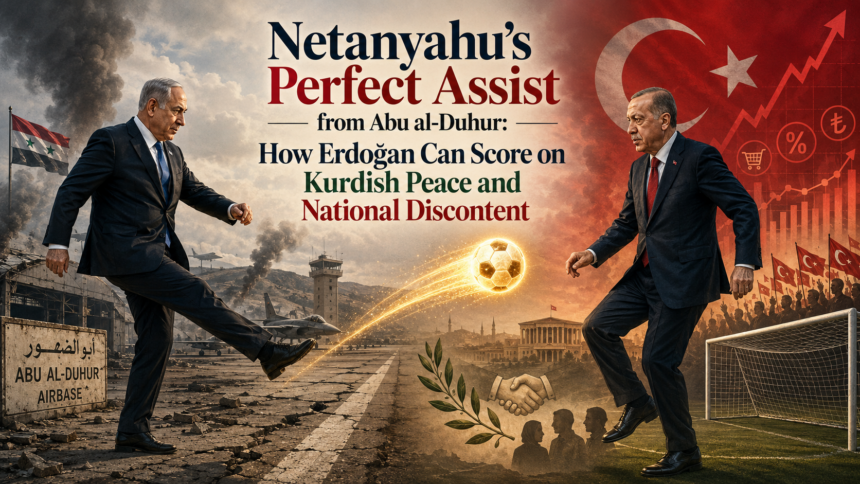
Netanyahu’s Perfect Assist
This is why Abu al-Duhur should not primarily be understood as the opening shot of an inevitable Israeli-Turkish war.
It is better understood as a particularly dramatic episode in a politics of reciprocal antagonism: sufficiently real to frighten and mobilize voters, sufficiently dangerous to make nationalist rhetoric credible, but sufficiently controlled that both governments continue building mechanisms to prevent the confrontation from reaching mutual destruction.
For Netanyahu, Abu al-Duhur demonstrates that Israel can still restrict Turkey’s strategic expansion in Syria.
For Erdoğan, however, the potential return is much larger.
He can use Netanyahu to move inflation and purchasing-power decline away from the center of political discussion.
He can use an external threat to subordinate questions about İmamoğlu, the judiciary and democratic competition to national security.
He can use Israel to provide a strategic justification for ending the Kurdish conflict.
He can use Öcalan’s reported anti-Israel discourse to make Öcalan less unacceptable to nationalist and conservative voters.
He can use Aktaş’s “Israel factor” argument to recast Kurdish integration as the defence of Turkish territorial integrity rather than a concession to separatism.
He can redirect nationalism from an internal Kurdish enemy toward an external Israeli enemy.
And he can attempt to construct a broader political coalition without surrendering the centralized and increasingly authoritarian political system over which he presides.
That is the real political opportunity created by Abu al-Duhur.
Netanyahu may have intended to prevent Erdoğan from scoring in Syria.
Instead, by bombing a Syrian airbase, later identifying Turkey as the reason, personally warning Erdoğan and allowing the confrontation to enter both countries’ electoral narratives, he may have delivered the Turkish president a nearly perfect cross.
Erdoğan now has the opportunity to turn a foreign-policy setback into evidence of Turkey’s importance, Kurdish reconciliation into national security, Öcalan into a newly tolerable interlocutor, economic frustration into external-threat politics, and national consolidation into a substitute for democratic accountability.
Whether Turkish voters allow him to finish the move remains an open question.
But the ball is at Erdoğan’s feet.