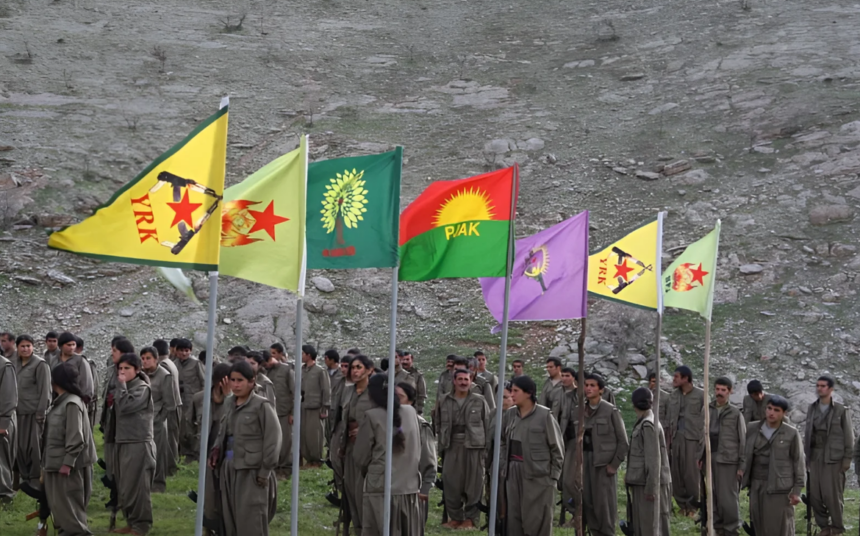
Since Abdullah Öcalan’s February 2025 call, the PKK has dissolved, Turkey has built a framework for disarmament and reintegration, and the SDF has surrendered its independent military existence to the Syrian state. PJAK alone remains armed while insisting that the same transformation does not apply to it. The most persuasive explanation is strategic: the Turkish and Syrian fronts have largely exhausted their usefulness, while an Iranian front may still have a future.
When Abdullah Öcalan issued his “Call for Peace and Democratic Society” on February 27, 2025, he did more than propose another ceasefire. He called on the PKK to convene a congress, dissolve itself and lay down its arms. The PKK subsequently held its congress in May, announced the dissolution of its organizational structure and formally terminated armed struggle under the PKK name. Turkey then began constructing the political and legal mechanisms necessary to move former militants out of armed struggle and into civilian life.
This matters for PJAK because Ankara has never treated the process as applicable only to an organization carrying the three letters “PKK.” Turkey considers the KCK the broader organizational framework, PJAK its Iranian manifestation and the PYD/YPG its Syrian manifestation. Ankara’s position has therefore been that dissolution should encompass the wider organizational system rather than simply the formal PKK structure.
PJAK nevertheless declared in August 2026 that the PKK/KCK dissolution had “no direct connection” to it. It portrayed itself as an independent Iranian Kurdish movement while simultaneously reaffirming Abdullah Öcalan’s ideological framework and making clear that it intended to preserve its organization.
The problem with that argument is not merely Turkey’s interpretation. Washington itself historically described PJAK very differently. In 2009, American authorities characterized PJAK as being “controlled by” Kongra-Gel/PKK and described PKK-linked leaders as helping establish a structure capable of presenting itself as independent. According to that assessment, the relationship extended to leadership selection, personnel allocation and PJAK’s armed activities.
PJAK certainly developed an Iranian political agenda and a degree of operational autonomy. But autonomy is not the same as organizational isolation. More importantly, the Syrian experience shows that the practical fate of these organizations has ultimately depended less on formal labels than on geopolitical usefulness.
When Öcalan issued his February 2025 call, Mazloum Abdi responded that it concerned the PKK and was “not related to us in Syria.” The logic was almost identical to PJAK’s present argument: common ideological origins did not mean that an autonomous regional organization was bound by decisions affecting the PKK.
For years, Washington could sustain that distinction because the SDF was an indispensable military partner against Islamic State. Ankara rejected it, but American strategic requirements gave the SDF the political space to maintain an autonomous military existence.
That protection weakened when the strategic environment changed. After negotiations with Damascus, mounting Turkish pressure and a broader movement toward restoring Syrian state authority, the SDF formally ceased to exist as an independent military force in August 2026. Its fighters entered Syrian state structures, senior Kurdish commanders received positions in the new military establishment, and Mazloum Abdi himself entered the presidential structure as an adviser.
The lesson is not that Öcalan personally ordered the SDF to dissolve. He did not. It is that the SDF’s claim to organizational independence protected its military autonomy only while that autonomy remained strategically useful. Once Washington increasingly favored Syrian consolidation, Ankara remained determined to eliminate a separate YPG-led military order, and Damascus acquired the means to impose integration, organizational terminology no longer determined the outcome.
That precedent makes the PJAK exception difficult to dismiss.
In Turkey, the armed organization is being dismantled and former militants are being directed toward civilian reintegration. In Syria, the Kurdish-led autonomous army has been absorbed into the state. Yet in Iran, PJAK remains armed and insists that the same process does not apply to it.
The distinction makes more sense when viewed geographically than organizationally.
An armed Kurdish organization positioned along Iran’s western frontier can threaten sensitive border areas, gather intelligence, force Tehran to disperse security forces, exploit internal instability and create an additional pressure point during another confrontation with Iran. PJAK does not need anything approaching the capability to defeat the Iranian state. Its strategic usefulness lies in making Iran more difficult and expensive to defend.
The events of 2026 demonstrated why such an option might be preserved. Iranian Kurdish armed organizations based in Iraqi Kurdistan discussed possible operations against Iranian security forces with American interlocutors, including the military and intelligence support such operations could require. Israeli contacts with Iranian Kurdish organizations also developed around scenarios involving pressure on western Iranian border regions and the diversion of Revolutionary Guard forces.
PJAK was among the organizations discussed within this environment.
The fact that a large Kurdish ground offensive did not ultimately materialize does not make the option irrelevant. It demonstrates the value of keeping the capability available. Military assets can be activated, expanded or held in reserve according to political circumstances. Once dismantled completely, however, they are considerably harder to reconstruct in the middle of a regional crisis.
PJAK’s potential importance therefore extends well beyond its present number of fighters.
The dissolution of the PKK does not erase the experience accumulated by its cadres. Former PKK militants possess decades of knowledge in mountain warfare, clandestine organization, intelligence, logistics and cross-border operations. Likewise, the integration of the SDF does not erase the military expertise accumulated by Syrian Kurdish commanders and fighters during more than a decade of war, including command systems, intelligence, communications, urban warfare, logistics and cooperation with sophisticated Western militaries.
If Iran becomes a major theatre again, PJAK could provide the surviving organizational platform through which some of that experience moves eastward.
That would not require entire former PKK or SDF formations to change flags. A relatively small movement of commanders, trainers, intelligence specialists and experienced veterans could matter much more than raw numbers suggest. Former PKK cadres could strengthen guerrilla organization and training. Veterans of the Syrian Kurdish forces could contribute battlefield, intelligence and command expertise. Iranian Kurdish recruits would provide territorial familiarity and the local social base.
PJAK would provide the infrastructure connecting them: leadership, bases, communications, clandestine routes and, most importantly, an Iranian political theatre.
What is potentially being preserved, therefore, is not simply PJAK’s existing fighting force but a structure capable of rapid expansion if regional circumstances make Iran a major active front again.
Its potential role could also extend beyond military operations.
Iranian Kurdish opposition has historically been fragmented among PJAK, the Democratic Party of Iranian Kurdistan, PAK, Komala and other organizations with different histories and political orientations. A serious crisis of the Iranian state, however, could create pressure for deeper operational coordination. PJAK’s armed infrastructure, Qandil connections and access to a wider transnational Kurdish network could allow it to become one of the important military centers of such a coalition, particularly if reinforced by experienced cadres from other Kurdish theatres.
The organization would not necessarily dominate Iranian Kurdish politics. It would not need to. Its importance could lie in becoming the armed nucleus connecting otherwise fragmented forces.
Nor would a future challenge to Tehran necessarily remain confined to Kurdish regions.
Iran’s Azerbaijani/Turkic population is another major political and geographical factor, especially in the northwest. Kurdish and Azerbaijani nationalist movements have substantial historical tensions and conflicting territorial narratives, making any durable alliance difficult. But periods of state crisis frequently produce tactical coalitions among forces that disagree profoundly over what should follow.
Under sufficiently severe conditions, sections of the Azerbaijani/Turkic opposition, Kurdish movements and other anti-government currents could cooperate around the immediate objective of weakening Tehran’s control. A simultaneous challenge extending across western and northwestern Iran would pose a far more serious security problem than an isolated PJAK insurgency.
PJAK could become one component—and potentially an important military organizer—within such a wider front.
Turkey would have obvious reasons to view that prospect with suspicion. Ankara continues to define PJAK as part of the broader PKK/KCK system and has no strategic interest in seeing another powerful Kurdish armed entity emerge in the region.
But PJAK does not pose the same immediate problem for Turkey that the SDF did.
The SDF controlled extensive territory along Turkey’s southern frontier, possessed tens of thousands of fighters, governed major population centers and strategic resources, and benefited from direct American military protection. PJAK’s principal orientation is toward Iran. It does not control an equivalent territorial entity immediately along Turkey’s border.
Ankara can therefore continue to insist that PJAK ultimately falls within the broader disarmament logic while treating the Iranian file with less urgency than it treated the dismantling of the Syrian autonomous military structure.
This also helps explain why the controversial İmralı notes circulated in August 2026 are potentially significant. The texts, purporting to record Öcalan’s July 20 and August 2 meetings, attributed unusually explicit observations about Iran and PJAK to him. Öcalan was represented as arguing that Iran could not simply remain as it was, comparing the Iranian system with Syria as it approached the end of an era, and discussing a regional initiative involving Iraqi Kurdish leaders and PJAK.
Whatever the ultimate provenance and accuracy of those circulated notes, the political logic attributed to Öcalan is striking. PJAK was not presented simply as another organization that should disappear. Instead, it was described as something that should be transformed and redirected within a changing regional environment.
That interpretation fits the broader pattern better than the idea that PJAK has suddenly become organizationally unrelated to the movement from which it emerged.
Washington did not suddenly discover that PJAK had always been wholly separate from the PKK; its own historical assessment said otherwise. Turkey has not stopped defining PJAK within the KCK structure. PJAK itself has not abandoned Öcalan’s political philosophy.
What has changed is the strategic function of the guns.
The PKK’s armed role in Turkey has reached the end of its political usefulness. The SDF’s autonomous military role in Syria has reached the end of its strategic usefulness. PJAK’s has not necessarily reached that point.
If another major confrontation with Iran develops, PJAK could become much more important than its current size suggests: a military nucleus for Iranian Kurdish opposition, a destination for selected experienced cadres from the former PKK and Syrian Kurdish military tradition, and potentially one component of a broader front involving Azerbaijani/Turkic and other Iranian opposition currents.
That possibility explains the PJAK exception far better than the sudden discovery of organizational independence.
PJAK is not simply the branch that escaped disarmament. It may be the branch whose disarmament has been postponed because its strategic function has not yet expired.
The Turkish front is closing. The Syrian front has been integrated into the state. The Iranian front may still lie ahead.