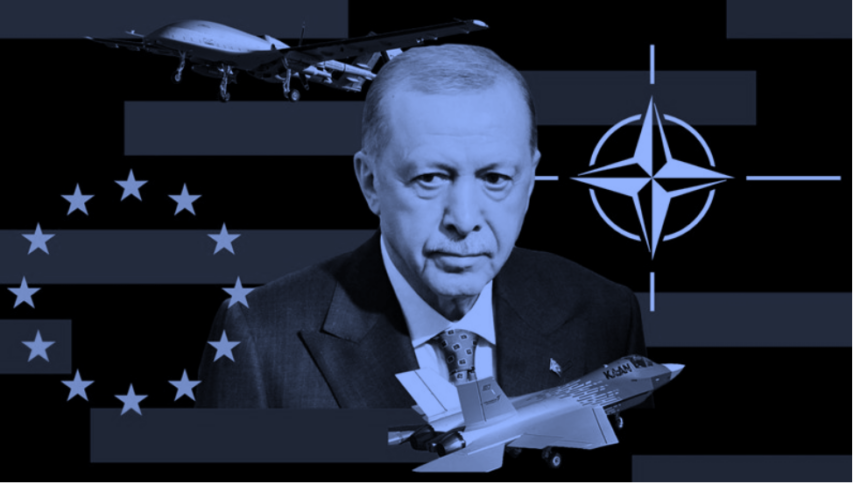
Cooperation through NATO, its role in the Black Sea and its industrial capabilities make Ankara an important interlocutor for Europe. A closer partnership is possible, provided it has concrete objectives and does not conceal differences over rights, foreign policy and the Eastern Mediterranean.
Two Tracks to Keep Apart
European security does not coincide with the borders of the European Union. Türkiye is a case in point: a NATO member since 1952, it occupies a central position between the Black Sea, the Mediterranean, the Caucasus and the Middle East. Its decisions affect the continent’s security conditions, regardless of its prospects of joining the EU.
The accession process, however, is a separate track. Türkiye has been a European candidate since 1999 and negotiations opened in 2005, but in 2018 the Council concluded that they had “effectively come to a standstill”, citing backsliding on democratic functioning, fundamental rights and judicial independence.
The Commission’s 2025 report describes a further deterioration: elections offer a choice but not a level playing field, and 28 opposition mayors have been arrested and removed from office. Cyprus remains a second obstacle: eight negotiating chapters stay blocked as long as Ankara does not apply the Additional Protocol to the Republic of Cyprus.
Closer cooperation is possible without immediate progress towards accession. It must, however, be built on verifiable commitments: Ankara’s strategic importance does not eliminate political differences, just as these differences do not erase shared interests.
NATO Offers a Foundation, Not a Solution to Every Disagreement
NATO membership provides an established framework for collective defence, planning and exercises. Türkiye is a major contributor to NATO’s collective defence. A member since 1952, it has the Alliance’s second-largest army and occupies a strategically important position between the Mediterranean and the Black Sea. NATO’s estimates put its 2025 defence expenditure at approximately US$32.6 billion, equivalent to 2% of GDP.
At the Hague summit in 2025, Allies committed to investing 5% of GDP annually in defence and security- related spending by 2035, comprising at least 3.5% for core defence requirements and up to 1.5% for broader
security-related investments. The Ankara summit of 7–8 July 2026 reviewed implementation of this commitment, with Allies announcing more than US$50 billion in new procurements and pledging €70 billion in military equipment, assistance and training for Ukraine in 2026. This was the second NATO summit hosted by Türkiye, following Istanbul in 2004. These contributions underline Ankara’s importance to European security.
Yet its role within NATO should not be equated with automatic alignment with European capitals on every regional crisis. For the EU, the question is how to link Atlantic cooperation to its own diplomatic, economic and industrial instruments. The two organisations have different functions and a different membership:
strengthening their complementarity requires political agreements, not merely technical compatibility.
A step in this direction came on 30 June 2026, when Foreign Minister Hakan Fidan met High Representative Kaja Kallas and Commissioners Marta Kos and Magnus Brunner in Ankara. The joint statement commits the sides to strengthen dialogue and cooperation on security and defence “incomplementarity with NATO”,
reaffirms Ukraine’s sovereignty and territorial integrity, stresses the need to prevent sanctions circumvention, supports the UN Secretary-General’s efforts in Cyprus, and pledges work on customs union modernisation, visa dialogue and migration management. It is a political orientation, not an operational agreement: the statement does not mention the Black Sea, the Eastern Mediterranean or the EU’s defence- industrial instruments. Its value will depend on what follows.
The Black Sea Makes Dialogue Indispensable
In the Black Sea, Türkiye’s role derives first and foremost from geography and the legal regime of the Straits. Türkiye’s role in the Black Sea derives from geography and from the regime of the Straits. Under the 1936 Montreux Convention, Türkiye may, when it is not a belligerent, bar the passage of belligerents’ warships, except those returning to their home port in the Black Sea (Article 19). Ankara announced such restrictions on 28 February 2022, after Russia’s full-scale invasion of Ukraine.
In February 2024 NATO Secretary General Jens Stoltenberg said the Straits were closed to naval ships, which also prevents Russia from bringing in additional warships, and urged allies to continue to respect the Convention.
Montreux, however, cuts both ways. The same closure keeps allied vessels from rotating into the Black Sea, and NATO’s Sea Breeze exercise has been held in distant waters since 2022. The Convention is thus an asset for Europe’s security and a constraint on its naval options, and Ankara decides how it is applied.
The most concrete cooperation so far is in mine countermeasures. Türkiye, Romania and Bulgaria signed a memorandum on 11 January 2024 and activated the MCM Black Sea Task Group on 1 July 2024, with command rotating among the three. On the sidelines of the Ankara summit in July 2026 they signed an amendment extending its mission to the protection of critical underwater infrastructure. These functions (navigational safety, infrastructure protection, lower risk for commercial shipping) directly concern the European economy and Ukraine’s access to markets: one estimate holds that around 90% of Ukraine’s agricultural exports rely on the routes through Romanian, Bulgarian or Turkish waters.
Ukraine: Collaboration and Room for Autonomy
Türkiye’s policy towards the war in Ukraine combines support for Kyiv with the maintenance of channels to
Moscow. Ukraine was the third-largest buyer of Turkish arms in 2021–25 (8.4% of exports), and Türkiye
hosted direct Russia–Ukraine talks in Istanbul in May, June and July 2025, which the Commission records as a facilitation role.
The same Commission report is blunt about the limits. Türkiye does not align with EU restrictive measures against Russia; it has taken some steps against circumvention through its territory, but the Commission urges better detection of military-use technology diversion, tighter controls on re-exports and action on Russia’s shadow fleet
For Europeans, this position may offer diplomatic opportunities, but it requires a realistic assessment. The availability of a channel does not guarantee an agreement, and an agreement does not guarantee that it will be honoured.
Useful collaboration should focus on limited, verifiable results: maritime security, protection of trade, humanitarian measures and, where appropriate, verification mechanisms. Any negotiating prospect must involve Ukraine and consider the conditions needed to make an agreement sustainable over time.
Türkiye’s diplomatic capacity can contribute to this work without implying that Ankara fully shares European priorities.
Defence Industry: Assess Projects, Not Just Political Relations
Türkiye’s defence industry has grown quickly. According to SIPRI, its share of global arms exports rose from
0.9% in 2016–20 to 1.8% in 2021–25 (+122% in volume), making it the world’s 11th largest exporter.
The picture is also one of interdependence. Türkiye imported most of its arms from European suppliers:
Germany (31%), Spain (29%) and Italy (19%). For Europe, the question should concern the contribution of individual projects to the availability and reliability of the necessary capabilities.
Cooperating does not mean buying without conditions. Interoperability, maintenance, access to components, information protection and continuity of supply need to be clarified. The same applies to intellectual property and export authorisations.
An industrial partnership should reduce specific vulnerabilities and allocate clear responsibilities. Replacing one external dependency with another, without operational alternatives, would not strengthen European autonomy.
Any participation in EU instruments must also respect their rules: NATO membership does not automatically entail access to every European programme.
The Eastern Mediterranean Remains a Decisive Test
Cooperation cannot be built by ignoring Greece and Cyprus. The European Council has stated the EU’s strategic interest in a stable and secure Eastern Mediterranean and attached particular importance to progress in the Cyprus settlement talks within the UN framework.
A credible strategic relationship must therefore include incident prevention, communication between authorities and the management of disputes through diplomatic and legal instruments. The interests of some European partners cannot be protected by sacrificing the security of others.
For Ankara, too, greater regional predictability would have economic value: energy infrastructure, trade links and investment require sufficiently stable conditions. Cooperation can create incentives for de-escalation, but these incentives must translate into verifiable behaviour.
A Concrete and Gradual Partnership
The most realistic model is cooperation structured by sector. Maritime security, infrastructure protection, emergency response and industrial projects can move forward through agreements with defined objectives, responsibilities and evaluation procedures.
This approach matches the EU’s own line. The European Council’s conclusions of 17 April 2024 call for engagement“ina phased, proportionate and reversible manner”, adding that Türkiye’s “own constructive engagement will be instrumental”; the European Parliament backed the same formula in June 2026. Reversibility serves to make commitments credible: if the conditions are violated, there must be foreseeable consequences.
The dialogue should also preserve space for universities, researchers and civil society. Reducing the relationship to the needs of governments alone would risk weakening precisely those ties that can sustain lasting collaboration.
Cooperating Without Confusing the Objectives
Türkiye can be a strategic partner for European security even without joining the Union. This possibility already exists in Atlantic relations and in forms of regional collaboration; it can be developed through more reliable agreements.
EU accession remains a different matter, subject to political and legal conditions that military cooperation cannot replace. At the same time, the enlargement stalemate should not prevent progress where shared interests exist.
The European choice is to build a relationship capable of producing security even in the presence of disagreements: verifiable agreements, protection of all Member States, respect for international law and the ability to address disagreements openly. It is on these results that the value of the partnership will have to be measured.