Israel’s Cold War value rested on its ability to contain Soviet-backed Arab governments. That strategic environment has disappeared. Today, Netanyahu’s wars are damaging American legitimacy and obstructing Washington’s regional plans, while Turkey is becoming central to the defense, energy and commercial architecture on which US power increasingly depends.
For decades, Israel’s exceptional position in Washington rested on three mutually reinforcing foundations: the historical and moral legacy of the Holocaust, strong domestic political support and a belief that Israel provided the United States with unique strategic value in the Middle East.
During the Cold War, that strategic argument was plausible. The Soviet Union had developed close military, political and economic relationships with Egypt, Syria, Iraq and other Arab nationalist governments. Moscow supplied them with weapons, military advisers and diplomatic support while using the Arab-Israeli conflict to expand Soviet influence across the Middle East and eastern Mediterranean.
Israel’s military victories, particularly after 1967, demonstrated that it could defeat Soviet-equipped Arab armies without requiring the deployment of American troops. Washington increasingly viewed a militarily superior Israel as a regional counterweight to Soviet influence. The transformation was gradual: the United States had initially resisted becoming Israel’s principal arms supplier, partly because officials feared pushing Arab governments closer to Moscow. But Soviet weapons transfers to left-leaning Arab states eventually persuaded US policymakers that preserving Israel’s military advantage served a broader Cold War purpose.
That world no longer exists.
From strategic asset to strategic liability
During this period, Washington could plausibly describe Israel as a strategic asset: a pro‑Western outpost against Soviet influence and Soviet-backed Arab regimes. That logic shaped the “special relationship” and helped justify extraordinary diplomatic and military backing. But even historians of that alliance were warning decades ago that a relationship built around Cold War utility could turn into strategic overhang once the geopolitical landscape changed.
That is where the United States is today. The problem is no longer whether Israel matters to Washington. It does. The problem is whether Israel, under Netanyahu’s wartime and expansionist approach, still helps the United States build a durable regional order for its interests.
The destruction of Gaza has fundamentally altered Israel’s position.
Israel’s campaign is the subject of an ongoing genocide case before the International Court of Justice. The court has not issued a final judgment on the merits, but it has repeatedly ordered provisional measures under the Genocide Convention, including measures requiring Israel to prevent prohibited acts and address the catastrophic humanitarian conditions faced by Palestinians in Gaza.
For a growing part of the international community, however, the legal distinction between an allegation and a final verdict no longer determines the political perception. Gaza’s destruction, mass displacement, starvation and civilian death toll have become inseparable from the image of Israel—and, because Washington supplies Israel with weapons and diplomatic protection, from the image of the United States.
The damage has spread beyond Gaza.
Israel expanded its military operations into Lebanon, occupied significant areas in the country’s south and insisted on retaining so-called security zones. It also seized additional Syrian territory and continued attacks inside Syria after the collapse of Bashar al-Assad’s government.
From Netanyahu’s perspective, these occupations and military operations create buffers against Hezbollah, Iran and other threats. From Washington’s perspective, they increasingly obstruct the stabilization of Syria and Lebanon, frustrate negotiations with Iran and generate new conflicts for which Israel expects continued American military and diplomatic backing.
An ally becomes a liability when it repeatedly creates crises that its patron must finance, contain and defend.
That is increasingly how Americans, including Trump and his senior officials, seem to view Netanyahu’s government.
The evidence increasingly suggests this view. Pew found in April that 60% of Americans view Israel unfavourably, up from 53% a year earlier, while 59% have little or no confidence in Netanyahu. By July, Pew found favourability toward the Israeli people had fallen to 52%, while unfavourable views of the Israeli government had climbed to 62%. Even among Republicans under 50, 57% now view Israel unfavourably.
Gallup’s 2026 numbers are still more politically significant. Americans now sympathize slightly more with Palestinians than Israelis, 41% to 36%. Among adults aged 18 to 34, the gap is 53% to 23%; among independents, it is 41% to 30%. That is not a fringe sentiment. It is a generational and electoral warning.
AP‑NORC reaches the same conclusion from a different angle. Forty percent of Americans say the U.S. is too supportive of Israel; among Democrats, that rises to 58%. Thirty-one percent of Americans say Israel’s military actions in Gaza constitute genocide, including about half of Democrats. Even among Jewish adults, 38% say the U.S. is being too supportive of Israel.
The rhetoric inside the administration has also changed dramatically. In a nearly three-hour interview with Joe Rogan on The Joe Rogan Experience, released on July 15, 2026, Vice-President JD Vance accused figures within the Israeli government of attempting to manipulate American public opinion and undermine negotiations with Iran in order to keep the war “going on indefinitely.” He also argued that Israeli influence had helped pull the United States into a conflict it might otherwise have avoided.
During the same interview, Vance entered even more controversial territory. He claimed that Jeffrey Epstein had connections to the “highest levels” of both American and Israeli intelligence and said Epstein appeared linked to left-of-centre elements of what he called the Israeli “deep state.” When Rogan mentioned possible ties to Mossad or the CIA, Vance treated such a connection as plausible. These claims remain unproven, and no publicly established evidence demonstrates that Epstein worked for Mossad. Their political significance lies less in whether they are ultimately substantiated than in the fact that a sitting American vice-president was willing to voice suspicions about Israeli intelligence influence that previous administrations would have considered politically untouchable.
His remarks also came against a striking institutional backdrop. In June, NBC News reported that the Pentagon’s Defense Intelligence Agency had raised Israel’s counterintelligence threat designation to “critical”—its highest level—amid concerns that Israel was surveilling senior American officials to obtain information about internal US deliberations over the regional wars. The White House and the Israeli Embassy denied the report. This does not substantiate Vance’s claims about Epstein, but it demonstrates that concerns about Israeli intelligence activity are no longer confined to the political fringes; they have become serious enough to reach the highest levels of the American national-security establishment.
Trump’s language toward Netanyahu has been similarly confrontational. According to Axios, Trump told the Israeli prime minister that Israel should redeploy its forces from Syria and Lebanon, warning bluntly: “They don’t want you there. You should redeploy.” Netanyahu’s office responded that he had emphasized Israel’s claimed need to maintain “security zones.” These are not merely tactical disagreements. They show that Israeli escalation, occupation and political influence are increasingly colliding with Washington’s broader priorities: ending open-ended wars, stabilizing Syria and Lebanon, reducing direct American military exposure and constructing a new regional economic order.
That change is now visible in Congress.
On July 15, more than half of House Democrats voted to remove $3.3 billion in military aid to Israel. The amendment failed by 314 votes to 104, and Republican support for Israel remained overwhelming. Nevertheless, the vote represented the most substantial congressional evidence yet that the Democratic consensus is disintegrating. Even House Democratic Leader Hakeem Jeffries, who opposed the amendment, said American policy toward Netanyahu’s government must change.
Israel therefore faces pressure from both ends of the American political spectrum.
Progressive Democrats increasingly associate Israel with Gaza’s destruction, Palestinian dispossession and American double standards. Younger conservatives increasingly view the relationship through a nationalist framework suspicious of foreign influence, military entanglement and open-ended aid.
Congress may remain more supportive of Israel than the public for years. But an alliance cannot maintain permanent political exceptionalism when its base of social support is eroding across generations and parties.
The international costs are even sharper. Arab Barometer says people across the region have “lost nearly all confidence in a U.S.-led regional order,” and now see Washington as one-sided and morally compromised. Pew’s June cross-national survey found that across 36 non-U.S. countries, a median of just 35% think the United States contributes to global peace and stability, while 63% say it does not. If U.S. hegemony rests partly on legitimacy, not only force, then underwriting Israel’s conduct in Gaza, Lebanon and Syria is corroding one of the foundations of American power.
Washington’s Turkey pivot is now more visible
This is the context in which Turkey’s strategic importance has surged.
The NATO summit held in Ankara on July 7 and 8 was more than a prestigious diplomatic event for President Recep Tayyip Erdoğan. It placed Turkey physically and politically at the center of Western security deliberations at a moment when NATO was debating defense spending, industrial production, Ukraine, Russia and the consequences of the Iran war. NATO also held its principal defense-industry forum in Ankara.
Trump’s visit was the first by a US president to Turkey in 11 years. He repeatedly praised Erdogan and Turkey: “We’re going to be taking the sanctions off,” and adding that Turkey had been “much more loyal than other countries that we think would be loyal.” He also signaled a willingness to consider F-35 sales and reinstate Turkey in the F-35 program., for his part, said he expected a “favorable decision” and that Turkey had received a U.S. “commitment” regarding five aircraft.
The contrast with Netanyahu was striking.
Netanyahu reportedly urged Trump to restrain Erdoğan and avoid supplying Turkey with weapons that would modernize its air force. Instead, Trump publicly defended Erdoğan, promised to remove sanctions and expressed openness to selling Turkey F-35 fighter jets.
This does not mean the F-35 issue has been resolved.
US law still prohibits Turkey from receiving the aircraft while it possesses the Russian S-400 air-defense system. Congress remains resistant, and Trump did not announce a finalized agreement in Ankara. A solution would require either the removal or neutralization of the S-400s and a legal path through congressional opposition.
But the direction of policy has changed.
For years, Washington’s question was how Turkey should be punished for defying US demands. At Ankara, the question became how Turkey could be reintegrated into advanced Western defense cooperation.
The most tangible sign of the shift is not the still-unresolved F-35 discussion but Washington’s approval of engines for Turkey’s indigenous KAAN fighter.
On June 24, the Trump administration formally notified Congress of its intention to authorize the sale of dozens of General Electric F110 engines worth more than $700 million. The engines will power early versions of KAAN, Turkey’s domestically developed combat aircraft.
Several lawmakers attempted to stop the transfer. Representative Dina Titus introduced a joint resolution of disapproval, supported by other members concerned about the S-400, Turkey’s regional policies and Erdoğan’s authoritarian rule.
But the 15-day congressional review period expired on July 9 without either chamber voting to block the transaction. The sale can therefore proceed to technical, contractual and licensing stages without further intervention under that review process.
Turkey’s growing importance is not based on ideological alignment or democratic affinity. It is structural.
Turkey has NATO’s second-largest military. It controls the Turkish Straits connecting the Black Sea and the Mediterranean. It borders Syria, Iraq, Iran, Georgia, Azerbaijan, Armenia and the European Union. It is positioned between Europe, the Caucasus, Central Asia, the Gulf and the Levant.
It also possesses a rapidly expanding defense industry producing drones, missiles, armored vehicles, naval platforms and aerospace systems. At the Ankara summit, Erdoğan called for the removal of defense-industrial restrictions among allies and demanded greater access to European security initiatives.
Turkey is simultaneously relevant to nearly every major theater of current US strategy:
It is essential to NATO’s southeastern flank and Black Sea access. It influences the post-Assad political and military order in Syria. It is a major commercial partner of Iraq. It provides routes toward the Caucasus and Central Asia that bypass Russia and Iran. It offers energy and transportation access between the Gulf and Europe.
Israel remains militarily powerful, but it cannot reproduce this geography.
That is why Washington is increasingly treating Turkey not merely as a difficult ally to manage, but as an indispensable node connecting security, defense production, energy and trade.
The Baniyas pipeline
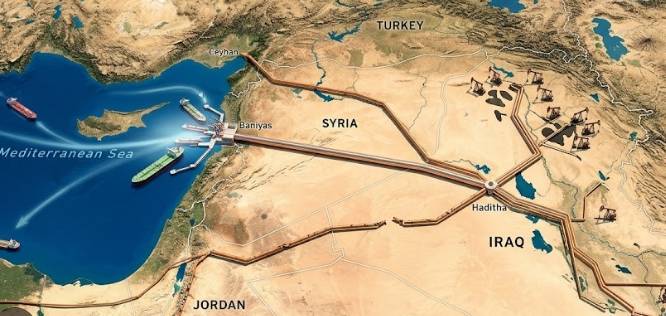
The Iraq–Syria crude pipeline agreement should be read in that broader frame. On July 17, the State Department welcomed the Iraq–Syria accord as a “priority infrastructure project of bilateral and regional strategic significance,” and said the rehabilitated pipeline would have an initial capacity of 2 million barrels per day. Washington also welcomed a U.S.-led consortium to handle the technical and financial work.
The groundwork was laid on July 4, when Iraq approved preliminary agreements for Basra Oil Company to work with a consortium including Capital TI, Chevron and Qatar’s UCC on technical and financial feasibility studies for two routes: Basra–Haditha–Kirkuk–Ceyhan and Basra–Haditha–Baniyas. These agreements create no final financial or contractual obligations for Iraq’s oil ministry; they are still exploratory. The envisioned network would connect southern Iraq to Haditha and onward to Turkey’s Ceyhan and Syria’s Baniyas, while Chevron signed a separate agreement to invest in an export pipeline out of Iraq.
The project’s commercial logic is obvious. Hormuz is now a strategic vulnerability for Iraq and for global markets. Goldman Sachs estimates seven pipelines under development in the wider region could carry roughly 14 million barrels per day by the end of 2028, equivalent to about 60% of the oil that used to pass through Hormuz before the war. Tom Barrack, the US ambassador to Turkey and a central figure in Washington’s Syria and Iraq policy, has said the new pipeline program could make Hormuz “an afterthought.” That is almost certainly too optimistic on the proposed timetable. Pipelines crossing several countries will take years to finance and construct, and the old infrastructure is badly damaged. But the ambition behind the statement is revealing.
A US-supported Iraq–Syria–Turkey export system would accomplish several objectives simultaneously.
It would reduce Iraq’s dependence on Hormuz and weaken Iran’s ability to threaten Iraqi revenues. It would reintegrate post-Assad Syria into regional commerce under Western and Gulf supervision. It would give American companies a major role in strategically important infrastructure. It would strengthen Turkey’s position as the bridge between Middle Eastern energy producers and European markets.
Most significantly, it would create a corridor strategy that does not require Israel.
This is where the Baniyas pipeline intersects with the wider contest over regional order.
The project should not be understood in isolation. It overlaps with Iraq’s Development Road, the Trans-Caspian Middle Corridor and proposals for a Four Seas framework connecting the Persian Gulf, Caspian Sea, Black Sea and Mediterranean through Iraq, Syria and Turkey.
Together, these routes form an emerging Turkey-centered network.
The Development Road is a proposed $17 billion rail-and-highway system connecting Iraq’s Grand Faw Port on the Gulf to the Turkish border. Iraq, Turkey, Qatar and the United Arab Emirates signed a preliminary cooperation agreement in 2024.
The Middle Corridor links Central Asia to Europe through Kazakhstan, the Caspian Sea, Azerbaijan, Georgia and Turkey. Unlike many grand corridor proposals, portions of it are already receiving substantial financing. In 2026, the World Bank approved $372 million for Georgia’s section and an $846 million guarantee intended to mobilize $1.41 billion for rail connectivity in Kazakhstan.
The World Bank also approved $2 billion for a new rail crossing of the Istanbul Strait, explicitly describing it as infrastructure connecting the Trans-Caspian corridor, the Turkey–EU route and Iraq’s Development Road.
This is not a single project. It is a corridor system.
Why this sidelines IMEC in practice
IMEC was conceived as a grand U.S.-backed corridor from India to the Gulf and onward through Jordan and Israel to Europe. Its 2023 memorandum envisioned two corridors, railway integration, electricity and digital cables, and hydrogen pipelines. In February 2025, the White House said U.S. and Indian leaders planned to convene IMEC partners within six months to launch new initiatives. On paper, IMEC still exists. In practice, however, the centre of gravity is moving elsewhere.
One reason is political toxicity. IMEC’s northern leg runs through Israel. That was once sold as a feature: a geo-economic reward for Arab–Israeli normalization. Today it is increasingly a liability. Turkey’s Erdoğan has long insisted that there can be “no corridor without Turkey,” and Carnegie describes the Iraq–Turkey Development Road as a joint Turkish–Iraqi response to IMEC.
The two projects are not identical. IMEC is a broad trade, rail, energy and digital system linking India to Europe. Baniyas is primarily an oil-export route connecting Iraq to the Mediterranean. The Development Road and Middle Corridor, rather than the pipeline alone, provide the fuller commercial competition.
But projects can be sidelined without being formally cancelled.
IMEC’s central political premise is that Israel can serve as a stable and acceptable anchor for regional integration. Netanyahu’s wars have severely weakened that premise.
Arab governments may preserve quiet intelligence, security and commercial contacts with Israel. But publicly organizing their economic future around Israeli territory has become far more politically costly after Gaza, Lebanon, Syria and the Iran war.
The Baniyas and Ceyhan routes do not carry that burden.
Iraq does not need to normalize relations with Israel. Syria does not need to permit an Israel-linked corridor across its territory. Gulf investors can support Mediterranean access without publicly embracing Netanyahu. Turkey can connect the resulting infrastructure to Europe while continuing to present itself as a ‘critic’ of Israel.
IMEC asks Arab governments to make Israel a permanent part of their economic geography at the moment Israel’s regional legitimacy is collapsing.
The Turkey-centered alternatives ask them to support energy security, reconstruction and trade.
That is an easier political proposition.
IMEC is also still largely a diplomatic commitment. The Development Road remains highly ambitious, and the Baniyas pipeline is only at the feasibility and preliminary-agreement stage. But parts of the wider Turkey-centered system are already receiving major multilateral investment, including rail infrastructure in Turkey, Georgia and Kazakhstan.
The competition is therefore increasingly asymmetrical.
IMEC has powerful sponsors and enormous theoretical potential. The Turkey-centered corridors have geography, several overlapping routes and growing urgency created by the Hormuz crisis.
The Baniyas pipeline is therefore more than an energy project. It represents an early American hedge against an Israel-centered regional order that has become politically costly, diplomatically restrictive and increasingly difficult to implement.
Preserving American Hegemony
In the emerging order, American hegemony depends increasingly on NATO cohesion, resilient energy routes, access to Central Asia, stability in Syria and Iraq and the ability to compete with China and Russia without appearing permanently hostile to the populations of the Middle East.
Netanyahu’s Israel obstructs many of those objectives. Turkey is central to nearly all of them.
Washington is therefore approaching an uncomfortable conclusion: protecting Israel from every consequence of its actions may eventually cost the United States more than Netanyahu’s government contributes to American power.
The Baniyas pipeline is the latest sign of the alternative.
Israel is becoming the ally Washington must restrain to prevent further damage to its global position.
Turkey is becoming the power Washington needs if it hopes to preserve it.
By: GEOPOLIST – Istanbul Center for Geopolitics