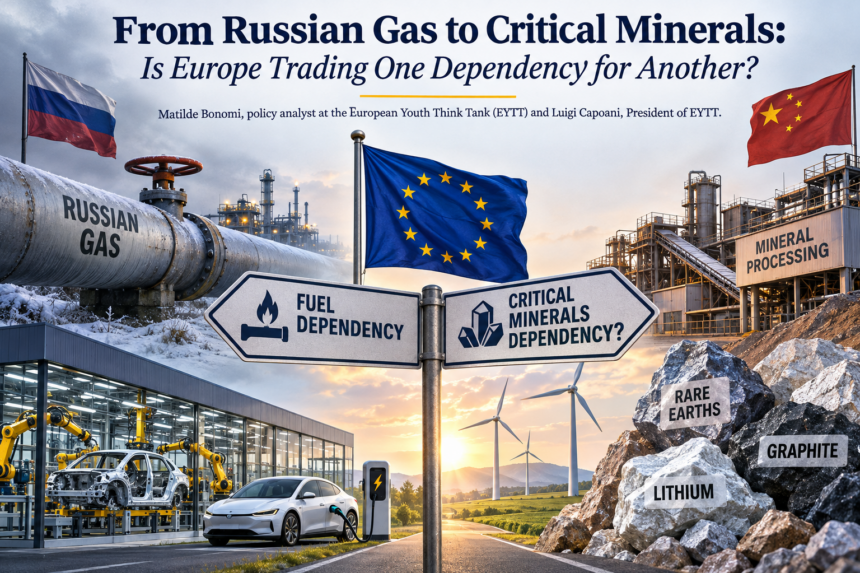
Matilde Bonomi, policy analyst at the European Youth Think Tank (EYTT) and Luigi Capoani, President of EYTT.
When a gas delivery stops, a power plant can run only as long as it has access to fuel. When shipments of rare-earth magnets stop, a wind turbine already connected to the grid can keep generating electricity. The shortage hits on the factory assembling the next turbine, the operator waiting for a spare part or the carmaker whose line falls idle. Europe’s energy transition therefore reduces the leverage a fuel supplier holds in a winter shortage, but it also makes the pace of electrification and the location of future factories more sensitive to disruptions in mineral processing and component manufacturing. Strategic autonomy depends on whether European industry can find alternatives before those disruptions force it to cut production.
What Europe learned from Russian gas
Russia supplied about 45 percent of EU gas imports in 2021, while in 2025 this number dropped to 12.5 percent (or 36 billion cubic meters) according to the European Commission calculation. Over the same period, liquefied natural gas (LNG) rose from 20 to 45 percent of total EU gas imports, with the United States supplying 58 percent of it, which according to the European Union Agency for the Cooperation of Energy Regulators (ACER) is roughly a quarter of all EU gas imports. In January 2026, the Council adopted a phased ban on Russian gas, with the full prohibition scheduled to apply to LNG from the beginning of 2027 and to pipeline gas from autumn 2027.
A cargo can be redirected more easily than a pipeline can be rerouted. It still takes a ship, a terminal with spare capacity and a supplier willing to sell at a price Europe can afford. When buyers in several regions compete for the same cargoes, diversifying routes can keep gas flowing while households and factories remain exposed to higher prices. The geopolitical gain comes from lowering demand, because every unit Europe doesn’t buy is one a supplier can’t withhold or reprice against it. Yet EU gas consumption rose 2 percent in 2025 and electrification only pays off where it displaces gas.
The bottleneck is often after the mine
Lithium in a battery and rare earths in a magnet are embodied in equipment. So, the immediate risk from a shortage falls mainly on new production, installation and repairs and it can still be severe. A battery factory that runs short of a particular grade of graphite may have to slow production while it tests a replacement. If that happens repeatedly, a manufacturer may decide to build its next factory closer to the suppliers it can count on.
Buying ore from several countries offers limited protection if it all passes through the same processing hub. The International Energy Agency’s (IEA) 2026 outlook found that, on average, the leading refiner accounted for 70 percent of the key energy minerals it tracks in 2025, a record, up from 68 percent in 2020. Excluding rare earths, the largest refining country’s average share across the key minerals rose from 70 percent in 2023 to 72 percent in 2025. China controls 60 percent of
global rare-earth elements and is the leading refiner for most of these minerals. In 2025, it made more than 80 percent of the world’s lithium-ion battery cells and 70 percent of EVs.
The European Court of Auditors (ECA) report found that the EU is fully dependent on imports for 10 of the 26 critical raw materials needed for renewable energy technologies, that none of the rare earths used in the EU are processed domestically, and that efforts to diversify imports are not producing results. The EU sources 98 percent of its rare-earth magnets from China, and the European Central Bank has estimated that over 80 percent of large European firms are no more than three intermediaries away from a Chinese rare-earth producer, with few holding stocks.
Set against Russian gas, these numbers are alarming. In magnets, Europe’s reliance on a single supplier is more than twice Russia’s peak share of EU gas imports, though in a far smaller market. The point is that gas was bulky and visible. Magnets are small, cheap and invisible until they are missing: the IEA says rare earths are about 40 percent of a permanent magnet’s cost but under 1 percent of a vehicle’s value. Its estimate is that around $6.5 trillion of annual downstream production outside China could be jeopardised if the October 2025 controls were fully enacted, partly because they would require approval for magnets containing as little as 0.1 percent Chinese- sourced rare earths.
A licensing regime is also a more flexible instrument than an embargo. It can be tightened for one sector, eased for one country and reversed overnight, and the mere possibility of tightening makes firms hesitate over new investment. Moscow had to cut flows to use gas as leverage. Beijing can use minerals simply by controlling how quickly applications are processed.
Europe can change what it needs
Technology gives Europe some room to reduce its exposure. Lithium iron phosphate batteries avoid the nickel and cobalt used in some other lithium-ion chemistries. They still require lithium, and changing chemistry can shift dependence to a different set of suppliers. The IEA estimates that almost all lithium iron phosphate batteries used in EU electric vehicles in 2025 came from China, about 30 percent as batteries and nearly 70 percent already fitted in imported vehicles. Dependence can arrive inside finished cars, where raw-material statistics never see it. A buyer choosing a cheaper chemistry should therefore consider whether it can qualify a second supplier for the cell and its key materials.
Recycling gives Europe another potential source, but timing matters. A battery sold today may stay in service for years, while a factory needs inputs now. Manufacturing scrap can provide material sooner. Over time, collection and designs that make batteries easier to dismantle can increase recovery from used products. Yet recycling is a lever the EU is barely using: the ECA found that 10 of 26 materials aren’t recycled at all, so Europe needs to make it a core part of its strategy. The industrial test is how much recovered material meets manufacturers’ specifications and returns to production.
How to test strategic autonomy
The EU’s Critical Raw Materials Act sets 2030 benchmarks for capacity equivalent to at least 10 percent of EU annual consumption of strategic raw materials for extraction, 40 percent for processing and 25 percent for recycling. It also aims to ensure that no single non-EU country supplies more than 65 percent of annual consumption of each strategic material at any relevant stage ofprocessing. In October 2026 the Commission designated 46 more strategic projects, bringing the total to 106. Yet the ECA warns that many strategic projects will struggle to secure supply by 2030, and the market is not helping: the IEA reports that critical-mineral investment fell 9 percent in 2025, and battery-materials companies cut theirs by 20 percent. Even on planned projects, magnet production in 2035 would amount to only about a third of expected rare-earth mine output, according to IEA. The number to watch is not how many projects are designated but how many deliver materials that European manufacturers have qualified and agreed to buy.
Policymakers should ask what would happen if the leading supplier of a specific grade of graphite or magnet material stopped shipping for six months. Which factories would have to slow production? How long would inventories last? Could another supplier meet the required specifications in time? The answers would help distinguish where stockpiles could bridge a temporary gap and where Europe needs a second processor, a long-term purchase agreement or a redesigned component. They would also give governments a basis for deciding when the cost of supporting a second supplier is justified by the disruption it would help prevent.
Europe gains autonomy when it needs less imported fuel and can keep building and repairing the equipment that replaces it. Buying from abroad can support that aim when manufacturers have qualified alternatives. The lesson of Russian gas is to secure those alternatives while supplies are still flowing. Beijing is extending its pause two months at a time. Europe should read each extension not as relief but as a deadline.