Summary by Geopolist | Istanbul Center for Geopolitics:
The piece argues that the world is at a decisive turning point and that Arab states face a strategic test: are they actively shaping the emerging international order, or are they mostly being carried along by larger forces? The author says the answer is mixed—Arab states have shown moments of initiative, but not a consistently bold, region-wide vision for a genuinely new order. The essay’s central claim is that you cannot understand what “a new world order” will look like in the region unless you put the question of **Palestine at the center, because it functions as the clearest indicator of whether Arab states are truly asserting agency or remaining constrained within a U.S.-dominated system.
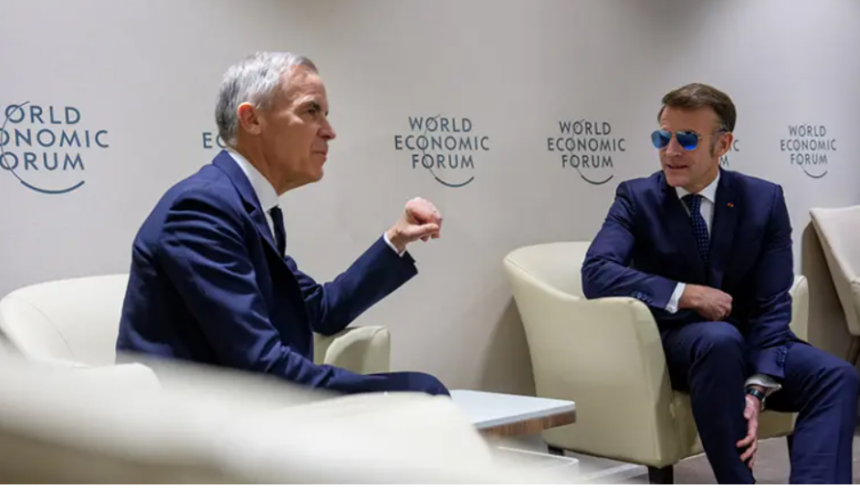
To frame this argument, the author highlights a speech attributed to **Mark Carney at the **World Economic Forum in **Davos, where he supposedly declared the “rules-based international order” effectively finished. The author portrays this as an unusually blunt admission that the old order never applied its proclaimed rules evenly and largely served Western power. In the piece’s telling, Carney urges “middle powers” to stop pretending otherwise and to build a new economic, political, and security infrastructure grounded in universal values and new rules—while warning that states now face a stark choice: either they have enough power to sit at the table, or they end up “on the menu.” The author, however, treats this vision as limited and somewhat hypocritical, arguing it is aimed mainly at Western-aligned middle powers rather than the Global South, and may be impractical given how dependent many states remain on U.S. power and how divided their interests are.
From there, the essay claims the **Donald Trump administration has not changed the fundamentals of U.S. dominance in the Arab world, but has “unmasked” it—abandoning liberal-institutional language in favor of an openly coercive, power-first approach. The author points to rhetoric associated with Trump-era strategy—such as preventing rival powers from dominating the Middle East and its energy routes—as evidence that Washington treats the region as a strategic space to control, not a rules-governed arena. The piece also argues that the administration is hostile to multilateral legal avenues that Global South states, including Arab governments, have tried to use to pressure **Israel over its conduct, because international law is seen as legitimate only when it serves U.S. and allied interests. In this reading, the emerging order is not a “new” order so much as a stripped-down version of great-power politics—“might makes right”—backed by U.S. military and economic muscle.
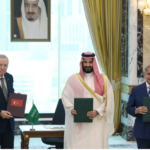
The essay then assesses whether Arab states—especially **Saudi Arabia—are successfully widening their strategic options. It notes signs of diversification, including Saudi rapprochement with **Iran and deeper ties with regional partners such as **Turkey, plus security arrangements involving **Pakistan. But it argues these moves sit alongside continued reliance on Washington, illustrated by large investment pledges and continued embedding in U.S. regional security architecture. That creates ambiguity: some steps look like the beginnings of regional autonomy and “regional multilateralism,” while others look like tactical appeasement that could actually reinforce the very U.S.-centric, coercive order Arab states might want to escape.
The author says this ambiguity becomes far less ambiguous once Palestine is treated as the litmus test. The piece notes that Arab and Islamic forums repeatedly affirm that Palestinian statehood is central to regional stability—citing statements and resolutions linked to the **Arab League and the **Organization of Islamic Cooperation, as well as diplomatic initiatives framed around a two-state solution. Yet the author argues that these declarations are undercut by the lack of decisive collective action. The essay portrays Israel’s repeated ability to strike across the region—including incidents referenced in places like **Doha—as evidence of broader regional sovereignty constraints, and it links that impunity to U.S. support and to the region’s failure to build an independent geopolitical strategy. In the author’s view, the clearest proof that Arab states are not “meeting the moment” is their inability—or unwillingness—to translate support for Palestinian sovereignty into hard policy choices, which the essay characterizes as the missing ingredient for a real rupture with the old order. (The author presents sweeping measures—up to full severance of ties—as the kind of action that would signal a genuine break.)
The concluding argument is that neither Trump’s explicit power politics nor Carney’s “updated liberal order” is sufficient. The author calls instead for a democratic global order in which states participate equally in designing new economic, political, and security structures, and urges middle powers—including **Canada—to align more seriously with Global South states. The essay ends by framing the current period as a rare historical opening: a chance to build a broad coalition that includes stronger and weaker states alike—explicitly including **China as a major power and the **State of Palestine as a self-determination case—arguing that what is ultimately at stake is not only Palestinian freedom but the sovereignty of Arab states and others beyond the region.
Read more here.