By using this site, you agree to the Privacy Policy and Terms of Use.
Accept
Geopolist | Istanbul Center for GeopoliticsGeopolist | Istanbul Center for GeopoliticsGeopolist | Istanbul Center for Geopolitics
  • Home
  • Geopolitics
    Geopolitics
    Discover professional insights into international relations, regional conflicts, and global power dynamics by visiting Geopolist. Keep up on the ways in which these changes impact…
    Show More
    Top News
    Turkey vs. Israel in a Hypothetical War: The Myths and the Realities
    August 6, 2025
    Operation Spiderweb: The Death of Strategic Depth in the Drone Age
    August 6, 2025
    The End of Vertical War: Operation Spiderweb and the Rise of Horizontal War-Making
    August 6, 2025
    Latest News
    Too Useful Against Iran to Disarm? The PJAK Exception
    August 29, 2026
    Netanyahu’s Perfect Assist from Abu al-Duhur: How Erdoğan Can Score on Kurdish Peace and National Discontent
    August 22, 2026
    Erdoğan Arms Ukraine as Putin Complicates Turkey’s F-35 Comeback
    August 16, 2026
    From C5 to C6: Turkey’s Geopolitical Reach Expands Toward China’s Western Frontier
    August 7, 2026
  • Security
    SecurityShow More
    Blocked by Politics, Turkish Defence Firms Enter Europe Through Industry
    May 21, 2026
    Erdoğan’s Self-Inflicted Airpower Wounds: How Turkey Lost the Skies
    December 26, 2025
    Ahmed al-Ahmed: The Hero Islamophobes and Anti-Immigrant Voices Did Not Expect
    December 15, 2025
    Five Turkish defense firms enter SIPRI Top 100 with record $10.1 billion in 2024 sales
    December 1, 2025
    Turkey’s Kızılelma drone fires radar-guided missile in beyond-visual-range test
    December 1, 2025
  • Commentary
    CommentaryShow More
    Too Useful Against Iran to Disarm? The PJAK Exception
    August 28, 2026
    Netanyahu’s Perfect Assist from Abu al-Duhur: How Erdoğan Can Score on Kurdish Peace and National Discontent
    August 21, 2026
    Erdoğan Arms Ukraine as Putin Complicates Turkey’s F-35 Comeback
    August 16, 2026
    Spitting on the Cross: The Rise of Anti-Christian Hostility in Israel
    August 11, 2026
    From C5 to C6: Turkey’s Geopolitical Reach Expands Toward China’s Western Frontier
    August 7, 2026
  • Economy
    • Energy
  • Regions
    • Europe
    • Middle East & Africa
    • Eurasia
  • Risk Advisory
  • Jobs
    • Jobs
    • Post a Job
  • Register
  • My Bookmarks
Reading: China’s Military Momentum: Why the U.S. Needs a New Arsenal of Democracy
Share
Notification Show More
Font ResizerAa
Geopolist | Istanbul Center for GeopoliticsGeopolist | Istanbul Center for Geopolitics
Font ResizerAa
  • Home
  • Geopolitics
  • Security
  • Commentary
  • Economy
  • Regions
  • Risk Advisory
  • Jobs
  • Register
  • My Bookmarks
  • Home
  • Geopolitics
  • Security
  • Commentary
  • Economy
    • Energy
  • Regions
    • Europe
    • Middle East & Africa
    • Eurasia
  • Risk Advisory
  • Jobs
    • Jobs
    • Post a Job
  • Register
  • My Bookmarks
Have an existing account? Sign In
Follow US
  • Advertise
© 2022 Foxiz News Network. Ruby Design Company. All Rights Reserved.
Geopolist | Istanbul Center for Geopolitics > Blog > Commentary > China’s Military Momentum: Why the U.S. Needs a New Arsenal of Democracy
CommentaryGeopoliticsSecurity

China’s Military Momentum: Why the U.S. Needs a New Arsenal of Democracy

Last updated: October 6, 2024 2:44 pm
By GEOPOLIST | Istanbul Center for Geopolitics Published October 6, 2024 3k Views 4 Min Read
Share
SHARE


Summary by Geopolist | Istanbul Center for Geopolitics:

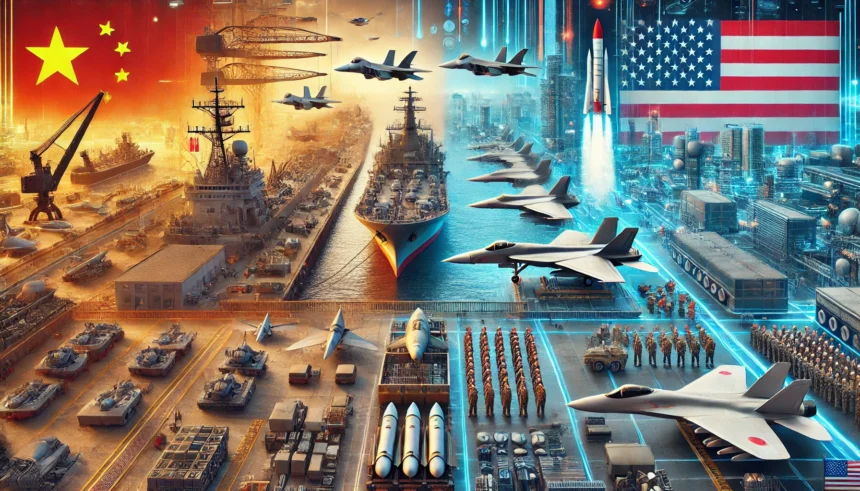
Seth Jones’s article in Foreign Affairs highlights the magnitude and rapidity of China’s military expansion and the deficiencies of the U.S. defence industrial sector in addressing this problem. China’s state-supported firms are swiftly creating modern weaponry, surpassing U.S. production and providing Beijing an advantage in an extended confrontation. Antiquated procurement systems, manpower challenges, and supply chain dependence hinder the U.S. defence sector. The author advocates for a substantial mobilization akin to Roosevelt’s WWII “arsenal of democracy” plan. Key points include;

Expansion of China’s Defense Industry:

Notwithstanding economic challenges, China’s defence expenditure and industrial capability have escalated, exceeding that of the U.S. in critical domains such as naval manufacturing and missile stockpiles.
State-owned businesses like the Aviation Industry Corporation of China (AVIC) and China State Shipbuilding, currently among the biggest defence companies worldwide, are driving Beijing’s military expansion.
The industrial base of China has expanded significantly in the last ten years. One Chinese shipyard surpasses the total capacity of all U.S. shipyards in naval manufacturing, rendering China’s navy the greatest globally by fleet size.


China’s Armament Systems and Technological Progressions:

In recent years, China has constructed over 400 fighter jets, 20 major warships, and has increased its nuclear arsenal.
China’s missile and space capabilities have developed considerably, featuring new ballistic and hypersonic systems aimed at U.S. bases in the Indo-Pacific region.
The PLA’s digital framework incorporates sophisticated technology, including artificial intelligence and big data, for command, control, and intelligence operations, rendering it a formidable entity.


Obstacles Confronting the U.S. Defense Sector:

The U.S. defence production system suffers from protracted timelines, elevated prices, and insufficient flexibility, rendering it inadequately prepared for the rapid needs of contemporary conflict.
Reliance on China for essential materials and components, such as microelectronics and batteries, engenders strategic vulnerabilities in the supply chain.
Labor shortages, especially in shipyards and manufacturing, have postponed critical military projects, so impeding U.S. military preparedness.


Strategic Recommendations for the United States:

The author advocates for a presidential push to rejuvenate U.S. defence production, similar to the mobilization efforts of the World War II era.
This entails expediting the contracting process, investing in proficient personnel, and prioritizing the multi-year acquisition of critical armaments.
Enhancing and modernizing U.S. shipbuilding capacity is essential to counter China’s naval construction supremacy.


Consequences for U.S. Allies and International Security:

China’s expanding military capabilities provide a direct threat to the security of U.S. allies and partners in the Indo-Pacific, including Japan, South Korea, and Taiwan.
The disparity in manufacturing capacity suggests that, in an extended conflict, China would probably possess an advantage in maintaining operations.
Absent a strategic realignment, the U.S. may encounter difficulties in projecting force inside the region or adequately supporting its allies.


A Request for Engagement:

The paper cautions that the United States must regard China’s military expansion as an imminent threat and transcend the existing peacetime mentality.
The United States must establish a contemporary “arsenal of democracy” capable of rapidly and efficiently creating advanced weaponry to discourage China and secure victory in a hypothetical great-power battle.
The essay asserts that the U.S. must enact comprehensive reforms to its defence industrial base to address China’s swift military ascendance. It necessitates elevated leadership and synchronized efforts throughout government and business to reinstate the U.S.’s capacity to manufacture and deploy military equipment at the scale needed to address the escalating strategic threat from China.

Read the full article here.

You Might Also Like

Too Useful Against Iran to Disarm? The PJAK Exception

Netanyahu’s Perfect Assist from Abu al-Duhur: How Erdoğan Can Score on Kurdish Peace and National Discontent

Erdoğan Arms Ukraine as Putin Complicates Turkey’s F-35 Comeback

Spitting on the Cross: The Rise of Anti-Christian Hostility in Israel

From C5 to C6: Turkey’s Geopolitical Reach Expands Toward China’s Western Frontier

Share This Article
Facebook Twitter Email Print
Previous Article Redefining Africa-Europe Relations: Navigating Power Shifts and Strategic Alliances in a Multipolar World
Next Article Forging Alliances: Japan’s Push for an Asian NATO
Leave a comment

Leave a Reply Cancel reply

Your email address will not be published. Required fields are marked *

Stay Connected

TwitterFollow
YoutubeSubscribe

Latest News

Turkey, Saudi Arabia and Pakistan Sign Landmark Mutual Defence Pact in Mecca
Eurasia Geopolitics Middle East & Africa
As Israel Becomes a Liability, Turkey Becomes Indispensable: Baniyas Marks the Latest Shift
Commentary Energy Geopolitics Middle East & Africa
Rethinking GCC Security Architecture After the U.S.–Israel–Iran War
Commentary Geopolitics Middle East & Africa
Blocked by Politics, Turkish Defence Firms Enter Europe Through Industry
Commentary Defence Technology Europe Geopolitics

Find Us on Socials

© GeoPolist. All Rights Reserved.
  • Submit an Op-Ed + Risk Advisory & Job Posting
  • Jobs
  • Post Jobs & Ads for Free
Welcome Back!

Sign in to your account

Register Lost your password?