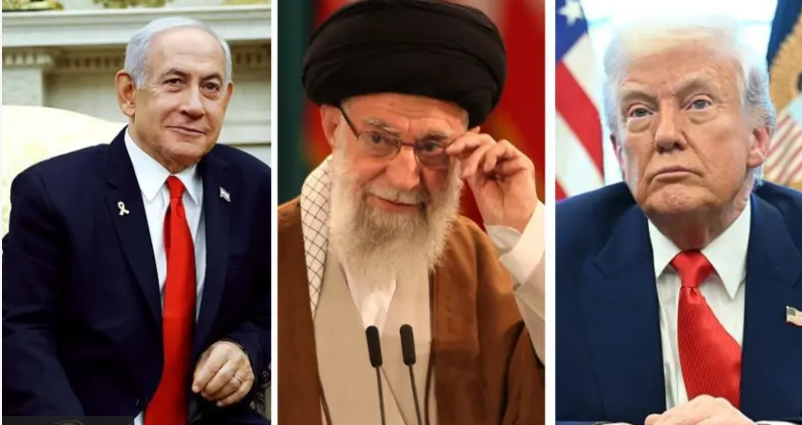
As the Iran-Israel confrontation escalates and Gaza endures catastrophic destruction, there is growing debate over whether the United States is adopting a posture shaped by Donald Trump’s “let them fight” perspective. This view, which Trump has articulated in relation to other conflicts, such as Russia and Ukraine, rests on the idea that allowing adversaries to continue fighting — within limits — may ultimately create conditions more favorable to diplomacy. Rather than intervening prematurely or expending U.S. resources unnecessarily, the goal is to let both sides reach a point where they recognize their need for American assistance, and thus become more open to compromise.
This thinking was evident in Trump’s recent meeting with German Chancellor Friedrich Merz. Speaking about Ukraine and Russia, Trump compared their conflict to “two kids fighting in a park,” suggesting that sometimes stepping in too soon only prolongs the struggle. He indicated that he had conveyed the same view to Vladimir Putin, and floated the idea of sanctioning both parties because, in his words, “it takes two to tango.” The message was clear: the U.S. should not always be eager to mediate or support one side until the warring parties themselves realize the costs of continued confrontation.
A similar thread can be seen in Trump’s disappointment with Israel regarding Gaza. During his presidency, Trump expressed frustration that despite his administration’s efforts to broker regional stability — including initiatives aimed at peace in Gaza — Israel showed little willingness to engage in meaningful negotiations or adjust its military posture. This perceived inflexibility, combined with what Trump saw as an Israeli focus on military solutions rather than political settlements, appeared to reinforce his view that external pressure would achieve little until realities on the ground shifted through the conflict itself.
Weeks before taking office for a second time, Trump shared a video on his Truth Social platform featuring American academic Jeffrey Sachs delivering a scathing critique of Israeli Prime Minister Benjamin Netanyahu.. In the video, Sachs describes Netanyahu as a “deep, dark son of a bitch” and an “obsessive” figure who, in Sachs’s view, has persistently worked to draw the U.S. into endless wars. The speech links Netanyahu to the Iraq invasion, suggesting that his long-standing strategy has been to push for toppling governments—first Iraq, then Syria and Iran—as a way to eliminate threats like Hamas and Hezbollah. Sachs asserts that Netanyahu is still trying to pull the U.S. into a war with Iran, warning that Israel’s current actions risk inflaming regional tensions beyond control.
Applied to the current Iran-Israel conflict, Trump’s perspective may represent more than passive restraint — it may reflect a calculated attempt to create leverage over Israel at a critical juncture. By allowing Israel to engage in limited strikes against Iran without immediately offering increased military aid or weapons shipments, the U.S. could be positioning itself to strengthen its influence over Israeli decisions. In this scenario, as the confrontation with Iran stretches Israeli capabilities and deepens its security challenges, Israel would eventually come to the U.S. seeking additional assistance. This, in turn, could give Washington the leverage needed to push Israel toward broader concessions — including a serious commitment to peace in Gaza.
From this angle, Trump’s perspective is not about abandoning Israel or turning a blind eye to regional stability. Rather, it reflects a transactional logic: let the crisis run just long enough to make Israel recognize that only the U.S. can provide the military and diplomatic support it needs to restore security and prevent disaster. Once in that position, the U.S. could extract concessions not only on the Iran front but also on long-standing issues like Gaza, where Trump previously expressed frustration with Israel’s unwillingness to engage in meaningful peace efforts.
For Iran, Trump’s patience might also be designed to push Tehran toward new nuclear negotiations — not a return to the Obama-era Joint Comprehensive Plan of Action (JCPOA), which allowed Iran limited uranium enrichment under strict international oversight, but a tougher, more comprehensive agreement. In Trump’s vision, such a deal would impose stricter limits on enrichment, more intrusive inspections, and address ballistic missiles and regional destabilization.
Israel’s recent massive strikes on Iran’s nuclear and military facilities — including the assassination of senior military figures and nuclear scientists — may achieve short-term tactical objectives, but they often produce counterproductive strategic consequences for the Iranian regime. While these operations are intended to deter Iran’s nuclear ambitions and degrade its military capabilities, they frequently end up strengthening the regime at home. At times when the Iranian leadership faces deep internal discontent — fueled by economic crisis, corruption, and political divisions — such external attacks offer a valuable rallying point. They enable Tehran to portray itself as the victim of foreign aggression, inflame nationalist sentiment, and justify harsh crackdowns on dissent under the banner of national defense.
In other words, the Iran-Israel rivalry has been mostly rhetorical. Both Iran and Israel benefit domestically from their ongoing enmity. For Iran, as mentioned above the posture of resistance against Israel strengthens regime legitimacy and distracts from internal pressures. For Israel, the perception of an existential threat helps secure continued Western military aid and political backing. These dynamics complicate any assumption that further fighting will automatically drive either side toward genuine compromise.
Still, Trump’s “let them fight” perspective offers a lens through which to understand a possible U.S. strategy: not indifference, but an effort to shape the crisis in a way that ultimately enhances U.S. leverage and, potentially, opens the door to a more comprehensive settlement, including in Gaza. Whether this bet pays off will depend on the skill with which the U.S. times its intervention and the precision of its diplomatic engagement.