
The Houthi advance toward Bab el-Mandeb and renewed attacks on Saudi territory have created the first serious challenge for the Makkah Joint Defence Agreement. The question is not simply whether Turkey and Pakistan will stand with Saudi Arabia, but what collective defense will mean when deterrence risks turning into entanglement.
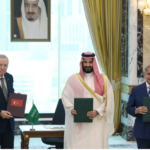
Yemen’s renewed conflict is becoming more than another phase in the country’s long war. The convergence of a major Houthi advance along the Red Sea coast, renewed missile and drone attacks on Saudi territory, and the creation of a new security arrangement linking Saudi Arabia, Turkey and Pakistan has turned the crisis into a test of the emerging regional order. On September 10, UN Special Envoy Hans Grundberg confirmed that Ansar Allah, commonly known as the Houthis, had taken Mokha, the strategic Red Sea port roughly 75 kilometres north of the Bab el-Mandeb Strait. There are also further Houthi advances toward Dhubab and the seizure of Mayun, or Perim, Island inside the strait. Those battlefield developments would already be important on their own, but they acquire much greater political significance because Saudi Arabia, Turkey and Pakistan signed the Makkah Joint Defence Agreement only on August 7.
The pact’s publicly announced principle is unusually strong: an armed attack against one member is to be regarded as an attack against all. Yet that commitment is broader in political language than it is in publicly defined operational terms. The full treaty text has not been released, and the three states do not yet possess anything comparable to NATO’s mature command structures, force-generation mechanisms or decades of integrated planning. Turkish Foreign Minister Hakan Fidan has described the mutual-defense principle as technically comparable to NATO’s Article 5 while also stressing that assistance would follow a request and consultations among the members and could range from intelligence and logistics to ammunition or military units. The significance of that distinction is now becoming apparent: the agreement clearly creates an expectation of solidarity, but the public record does not establish an automatic obligation for Turkey or Pakistan to conduct offensive operations inside Yemen.
The trigger is no longer hypothetical
Saudi territory has already been struck. On September 8, Houthi missiles and drones targeted southern Saudi Arabia, including areas around Abha, Khamis Mushait, Jazan and Najran. Saudi authorities said 73 civilians were wounded, while fires and temporary operational disruptions were reported at energy facilities. The following day, the Saudi-led coalition reported further ballistic-missile and drone attacks. Turkey and Pakistan both condemned the strikes and reaffirmed support for Saudi sovereignty and territorial integrity. The most revealing response, however, came from Pakistani Defense Minister Khawaja Asif, who said on September 8 that if the Yemen conflict spilled over into Saudi Arabia, the collective-defense commitment under the Makkah agreement could come into operation. Pakistan’s Foreign Ministry then stated on September 10 that no military response under the pact was being discussed at that stage.
Taken together, those statements suggest that Islamabad may already be drawing the most important line in the entire debate: an attack on Saudi territory can raise collective-defense obligations without automatically turning Pakistan into a combatant in Yemen. That distinction could become the organizing principle of the new alliance. It would allow the three states to treat protection of Saudi cities, infrastructure and territory as a common security responsibility while regarding offensive operations designed to shape Yemen’s internal political order as a separate decision requiring additional political and legal justification.
The challenge is that the Makkah framework is being tested before its institutions are fully established. The first meeting of the Strategic Political and Defence Committee took place in Istanbul only on August 31, when the three governments agreed to establish a permanent secretariat in Saudi Arabia, initially headed for three years by a Pakistani secretary-general, while expanding cooperation in defense technology and military industry. In effect, the alliance has reached the crisis stage before completing the institution-building stage. Riyadh can reasonably ask what the promise of collective defense means when missiles and drones hit Saudi territory, but Ankara and Islamabad must answer that question without an established body of doctrine explaining where their commitments begin and end.
Bab el-Mandeb has become more important, not less
The fall of Mokha gives this alliance debate a global economic dimension. It would be an exaggeration to equate control of the city with control of Bab el-Mandeb itself; Mokha lies north of the strait. What its capture does provide is a stronger Houthi position on the Red Sea coast and greater access to the approaches to one of the world’s most important maritime chokepoints. The subsequent movement toward Dhubab and Mayun is more consequential because those locations sit at or within Bab el-Mandeb itself. The Houthis do not need to establish uncontested sovereignty over the strait to impose costs. The credible ability to threaten commercial vessels, increase insurance premiums, disrupt schedules and force ships onto longer routes is itself a form of strategic leverage.
The economic stakes have risen because the disruption of the Strait of Hormuz has made the Red Sea corridor more important to global energy flows. According to U.S. Energy Information Administration figures cited in the research, roughly 8.1 million barrels of oil per day passed through Bab el-Mandeb in the second quarter of 2026, while flows through Hormuz had fallen to around 4.9 million barrels per day during the same period. Those figures should not be read as evidence that Bab el-Mandeb has permanently replaced Hormuz in strategic importance, but they show how rapidly global trade patterns adjust when one chokepoint becomes unreliable.
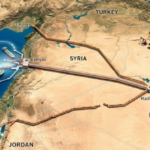
For Saudi Arabia, this creates a particularly difficult geometry. The kingdom’s East-West pipeline allows crude to be transported from eastern producing regions to Red Sea terminals, reducing dependence on Hormuz. Yet moving oil westward does not remove maritime vulnerability; it simply shifts the point of exposure. Cargoes traveling from the Saudi Red Sea coast toward Asian markets still depend on safe passage through Bab el-Mandeb unless they are rerouted around Africa. UNCTAD has estimated that Cape of Good Hope diversions can add roughly 12 days to Asia-Europe voyages and increase transit times by about 30 percent. The strategic equation is therefore straightforward: instability around Hormuz increases the value of Saudi Arabia’s Red Sea outlet, and that in turn increases the significance of Houthi military power near Bab el-Mandeb.
Oil markets are already reflecting the broader two-chokepoint risk. The research shows Brent climbing above $100 and briefly reaching more than $108 on September 11 before retreating as reports of possible diplomacy around Hormuz eased some of the pressure. It would be wrong to attribute that move solely to Mokha; the wider Iran conflict, tanker attacks, supply constraints and disruptions to Gulf infrastructure all contributed. But the volatility demonstrates that Yemen is no longer a peripheral battlefield whose consequences can be isolated from global energy security.
Therefore, Iran is central to this confrontation, but the language used to describe its role matters. There is considerable evidence that Tehran has provided the Houthis with weapons, technology, training and military advice, and recent reporting cited in the research indicates that Iranian arms and Revolutionary Guard assistance contributed to the latest offensive. Tehran nevertheless denies directing Houthi operations, while Ansar Allah has its own leadership, domestic political base and decision-making structures.
Pakistan has confronted this problem before
For Pakistan, the present crisis revives a dilemma that first became acute in 2015. When Saudi Arabia sought Pakistani military participation in its intervention in Yemen, Pakistan’s parliament called for neutrality in the Yemeni conflict while simultaneously affirming that Islamabad would defend Saudi Arabia’s territorial integrity. That formulation now looks less like an historical footnote and more like a ready-made doctrine for implementing the Makkah agreement. Pakistan has deep military, financial and political ties with Riyadh, but it also shares a border with Iran and has strong strategic reasons to avoid being drawn into a sustained Saudi-Iranian confrontation.
Khawaja Asif’s September 8 statement is therefore especially important. By saying that a spillover into Saudi territory could activate the pact, he identified a possible threshold for collective action without claiming that Pakistan is obliged to participate in a campaign inside Yemen. Islamabad could fulfill alliance commitments through air-defense support, counter-drone systems, surveillance, intelligence sharing, logistics or protection of critical Saudi infrastructure while still maintaining that decisions about strikes inside Yemen require separate political authorization. This would not eliminate controversy, but it would provide a coherent principle around which both alliance credibility and Pakistan’s regional balancing strategy could be organized.
Turkey has more room to maneuver—but also more at stake
Turkey’s calculation is different. Ankara politically supported the Saudi-led intervention in 2015 and indicated that it could provide intelligence and logistical assistance, but it did not become a major direct combatant in Yemen. Since then, Turkish-Saudi relations have gone through confrontation, reconciliation and a significant expansion in trade, defense industry cooperation and strategic coordination. The Makkah agreement now gives that relationship a formal security dimension that did not exist a decade ago. Riyadh will therefore expect Turkish support to carry more weight than another diplomatic statement if attacks on Saudi territory become sustained.
Yet Turkey also has strong reasons to keep the new pact from evolving into an automatic intervention mechanism. Ankara maintains an important, if competitive, relationship with Iran and has repeatedly tried to preserve diplomatic channels with Tehran even when the two sides have supported opposing actors elsewhere in the region. Turkish strikes inside Yemen would therefore represent a much larger strategic choice than deploying defensive capabilities on Saudi territory. They could pull Ankara deeper into the confrontation with Iran and transform a mutual-defense arrangement into a framework through which one member’s regional war becomes a responsibility shared by all.
The experience of Yemen itself also argues for caution. The Saudi-led intervention launched in 2015 enjoyed overwhelming advantages in aircraft, financing and military technology, yet it did not remove the Houthis from northern Yemen or create a stable political order. The anti-Houthi camp remains fragmented among forces with different patrons, political goals and territorial ambitions, including factions associated with the Presidential Leadership Council, Tariq Saleh and southern separatist movements. Some of the detailed battlefield claims circulating during the latest fighting remain difficult to verify, but the broader political fragmentation is not in doubt. Additional outside firepower may alter local military balances; it cannot by itself resolve the political divisions that have prolonged the war.
The pact needs procedures, not just promises
This is why the most immediate challenge for the Makkah agreement is institutional rather than theatrical. If Saudi Arabia formally requests assistance, Turkey and Pakistan have numerous ways to demonstrate that the alliance is meaningful without committing themselves at once to offensive war: intelligence fusion, early-warning systems, air and missile defense, counter-drone capabilities, maritime surveillance, cyber and electronic support, logistics and protection of Saudi energy infrastructure. These options fall comfortably within the range of assistance already associated with the pact and directly address the threats Riyadh faces.
What the three governments now need is greater clarity about procedure. They should define what constitutes an armed attack under the agreement, how attribution is established when a non-state actor is involved, what level of support can be requested, whether action outside an ally’s territory falls within the pact, and what political authorization is required before the alliance escalates from defense to offensive operations. A formal request for assistance should trigger a joint intelligence assessment, legal review, agreed rules of engagement and clearly defined objectives. Without such safeguards, the next missile strike could produce pressure for decisions that the alliance has never properly debated.
Clear limits would not weaken deterrence. They could strengthen it. An alliance is more credible when both its members and its adversaries understand the circumstances under which it will act. Excessive ambiguity risks creating miscalculation on both sides: partners may assume commitments that others never intended to fulfill, while adversaries may test boundaries because they do not know which attacks will provoke a collective response.
Yemen may define the alliance sooner than expected
The Makkah pact was conceived as a statement of strategic solidarity, but Yemen may force its members to decide what that solidarity means in practice far sooner than expected. Saudi territory has been struck, Houthi forces have strengthened their position along the Red Sea coast, and the instability surrounding Hormuz has increased the economic importance of the very maritime route that Bab el-Mandeb controls. Riyadh therefore has legitimate reasons to ask what collective defense means when the threat has moved from theory to reality.
The answer should not be measured simply by whether Turkish or Pakistani aircraft eventually strike targets in Yemen. A more meaningful test is whether the three states can protect Saudi territory, preserve the pact’s deterrent credibility and respond proportionately without allowing a newly created alliance to become an automatic mechanism for entering another open-ended conflict. Khawaja Asif’s statement already points toward one possible doctrine: attacks on Saudi territory may activate common defense, but intervention inside Yemen is a separate decision.
That distinction may prove decisive. If Turkey and Pakistan offer no meaningful help while Saudi Arabia faces sustained attack, the pact’s credibility will inevitably be questioned. But if the agreement is interpreted so broadly that every regional conflict involving one member becomes a military responsibility for all, the alliance could create its own form of strategic vulnerability.
Yemen could indeed become the first test of the Turkey–Pakistan–Saudi defense pact. Passing that test will require more than demonstrating willingness to use force. It will require showing that the three countries can defend one another without allowing collective defense to become collective entanglement.