The war that began on February 28, 2026 is not only testing the military endurance of the Islamic Republic. It is testing the survivability of the doctrine that gave the republic its deepest claim to legitimacy: wilayat al-faqih, the guardianship of the jurist. The immediate shock is obvious enough. Supreme Leader Ali Khamenei was killed in the joint U.S.-Israeli strikes, Iran moved into the constitutional succession mechanism, and a temporary leadership structure was formed that includes President Masoud Pezeshkian, the head of the judiciary, and a Guardian Council jurist. At the same time, the IRGC (Islamic Revolutionary Guard Corps) has taken on an even larger role in wartime decision-making. Those are not ordinary disturbances inside the system. They are disturbances at the very point where theology, coercion, and constitutional power meet.
The usual way of telling this story begins in 1979, with Ayatollah Ruhollah Khomeini and the Islamic Revolution. But that is too shallow. The Iranian state made wilayat al-faqih into a constitutional doctrine after 1979; it did not invent the underlying problem then. The deeper issue reaches back to the earliest Shi’i dispute over authority after the death of the Prophet Muhammad. The earliest division concerned whether authority should have remained within the Prophet’s family through Ali and then his descendants, or whether the community could choose its own rulers. That original dispute did not yet produce a doctrine of “guardianship of the jurist” in the later, technical sense. But it did produce the foundational Shi’i conviction that legitimate authority is not merely political or elective; it is morally and spiritually anchored in a sacred line of guidance. That is the soil from which all later Shi’i theories of authority grew.
The decisive transformation came later, with the doctrine of the Occultation. Once Twelver Shiism held that the Twelfth Imam had gone into hiding and would return only at the end of time, it faced a permanent political and legal question: who, if anyone, could act with authority during his absence? The early scholars of the Major Occultation did not believe the ulama could form a fully legitimate Shi’i government in the Imam’s absence. Their approach was far closer to principled restraint, limited authority, and uneasy coexistence with unjust rulers. In that sense, classical Twelver Shiism was not born as an activist theory of clerical sovereignty. It was born with a tension between sacred authority and political absence.
That point matters because it means the likely decline of wilayat al-faqih would not necessarily mean the decline of Shiism as such. It would mean the decline of one historically contingent answer to the question of authority in the Imam’s absence. Early Twelver thought preserved the supremacy of the Imam while withholding full legitimacy from all actually existing rulers. What later changed was the scope of authority granted to jurists. Over centuries, jurists accumulated interpretive, judicial, fiscal, and communal functions that had once been understood as more tightly bound to the Imam. This can be viewed as a long politicization of Twelver doctrine, especially through the gradual expansion of juristic prerogatives during the Occultation.
That expansion was closely tied to the rise of the Usuli school over its rivals. This can be traced to the growing dominance of the rationalist jurist-theological tradition associated with the Oṣuliyya, while Akhbari and other more traditionalist currents were pushed aside. The later dispute between the Akhbari and Usuli branches shows that the Usulis legitimized a broader use of ijtihad, or juristic reasoning, along with a hierarchical clerical authority. In contrast, the Akhbaris rejected the expanding claims of mujtahids to speak authoritatively beyond the transmitted reports of the Imams. This disagreement was not merely an academic quarrel; it represented a significant struggle over who had the authority to mediate divine law in the absence of the Imam.
The Safavid period was the next major turning point. When the Safavids made Twelver Shiism the religion of state in the early sixteenth century, they created the conditions for a much tighter relationship between throne and turban. The Safavid rule helped institutionalize a professional Shi’i clerical class and gave jurists expanding powers in collective prayer, taxation, justice, and public religious administration. Yet the Safavid settlement also contained a tension that would echo for centuries: the state needed clerical legitimacy, while clerics increasingly developed corporate interests and claims of authority that could outgrow dependence on the state. The architecture of an organized Shi’i clerical establishment was therefore a product not only of doctrine, but of state formation.
By the nineteenth century, this process produced the institution of marja’iyya, the idea that believers should emulate the most learned jurist. The emergence of the marja’ al-taqlid as a comparatively late development rather than a primitive feature of Shiism, tied to the ascendancy of the Usuli school and the consolidation of juristic authority. The development of marja’iyat and a’lamiyat elevated the most learned jurists to the status of translocal sources of imitation and practical leadership. While this did not constitute full state control by the jurists, it established the hierarchy, prestige, and social influence that were essential for Khomeini’s later theory to take shape.
The Constitutional Revolution of 1905–1909 then made the political stakes explicit. The issue was no longer simply how jurists should guide believers; it was whether monarchy itself should be limited by law, parliament, and public accountability, and what role clerics should play in that order. Some clerics supported constitutionalism as a restraint on despotism; others, such as Sheikh Fazlollah Nuri, demanded stronger clerical oversight and saw liberal constitutionalism as religiously dangerous. The crucial point is that modern Iranian Shiism did not march linearly toward Khomeini. It fractured over competing political futures: constitutional, monarchic, supervisory, and eventually theocratic. The post-1979 order was one resolution of that argument, not its inevitable endpoint.
Khomeini’s real innovation was to take a long-evolving set of juristic claims and convert them into a doctrine of sovereign government. In exile in Najaf, especially in lectures published in 1970, Khomeini argued that a just government in the Imam’s absence had to be overseen by a qualified faqih. This was the decisive leap. Previous Shi’i jurists had accumulated authority in law, education, taxation, and communal guidance. Khomeini turned juristic authority into constitutional sovereignty. He did not merely widen clerical influence. He sacralized the state by placing a jurist above it.
The 1979 constitution embedded that theory at the center of the new regime. The preamble explicitly links the revolution to wilayat al-faqih and presents the rule of the just jurist as essential to preventing deviation from Islam. Article 5 provides that, during the Occultation, leadership devolves upon the just and capable faqih. Article 107 gives the Assembly of Experts the task of selecting the Leader. Article 110 gives that Leader sweeping powers over general policy, the armed forces, war and peace, the Guardian Council, the judiciary, state broadcasting, and even the dismissal of the president. This was not a symbolic piety clause. It was the constitutional installation of juristic supremacy over the republican state.
Even so, the doctrine was already being altered from within. In 1989, after Khomeini’s death, Ali Khamenei became Leader despite lacking Khomeini’s religious stature. The system evolved to facilitate this change, and this adaptation proved to be more significant than it initially seemed. It signified a transition from governance by the most esteemed jurist to governance by a jurist who was politically acceptable, supported by revolutionary institutions. In other words, while wilayat al-faqih remained the highest authority in the constitution, its religious requirements were relaxed due to political needs. As a result, the office could maintain its powers, even while some of its original religious significance was diminished.
Under Khamenei, that process deepened. What had begun as a revolutionary theory of juristic guardianship gradually fused with a security state.After the death of Khamenei, the IRGC has taken on an even greater role in wartime leadership. Its decentralized succession planning has allowed it to continue functioning despite leadership losses. This situation is not solely a wartime detail; it illustrates the evolved nature of the Khamenei system. In this system, clerical supremacy is upheld in doctrine, while security supremacy takes precedence in practice. As the regime increasingly relies on the Guards for its survival, the concept of wilayat al-faqih becomes less about spiritual authority and more a legitimizing facade that conceals a military-bureaucratic core.
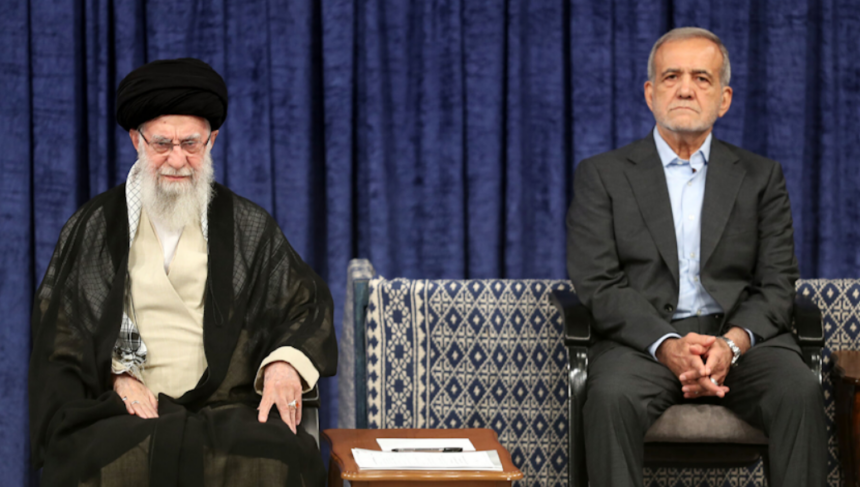
That is why the current war is so destabilizing at the doctrinal level. After Ali Khamenei’s death, the Islamic Republic fell back on the Article 111 mechanism, placing Masoud Pezeshkian, Gholam-Hossein Mohseni-Ejei, and Alireza Arafi at the center of an interim structure meant to preserve continuity until a new leader is chosen. Meanwhile, Mojtaba Khamenei has emerged as a leading contender, though major reporting still stops short of treating his elevation as publicly confirmed. If he does take the office, the damage to wilayat al-faqih may deepen rather than heal. A father-to-son transfer would strip the doctrine of much of its juristic mystique and make it look unmistakably dynastic. Pezeshkian may have deferred to Ali Khamenei as the established supreme authority of the system, but there is far less reason to expect the same deference toward a successor whose legitimacy would be contested from the outset. What the interim arrangement already reveals is that, in the moment of supreme crisis, Iran is being governed not by a singular sacralized jurist but by a provisional triangle in which the elected president has become unusually central. That is more than a temporary procedural detail. It is an early sign that the republic may continue even as the doctrine that once towered above it begins to hollow out.
This does not mean Pezeshkian has already replaced the doctrine. That would go beyond what the evidence supports. But it does mean that the war has opened a space in which the presidency can appear more necessary, more visible, and potentially more legitimate than the guardianship model itself. Pezeshkian was elected in 2024 as a reformist figure promising somewhat looser social restrictions and a less confrontational posture toward the West, even though the presidency remained subordinate to the Supreme Leader. If the succession drags, if the Assembly of Experts deadlocks, or if any new Leader lacks broad credibility, then the practical center of governance could continue shifting toward the president, cabinet, parliament, and security bureaucracy. That would not instantly create democracy. But it would further weaken the idea that only a faqih can stand at the apex of the system.
This is the context in which Pezeshkian’s rise matters. Constitutionally, Article 113 already makes the president the highest official in the country after the office of Leadership. In normal times, that clause is overshadowed by Article 110. In a post-Khamenei crisis, however, its importance grows. If Iran stumbles into a prolonged period in which executive administration, war management, economic stabilization, and diplomacy are increasingly handled by the presidency and by state institutions beneath the absent or weakened office of the Leader, then Iran could drift toward a post-guardianship republicanism without admitting it outright. In that scenario, wilayat al-faqih would not vanish in one legal stroke. It would decay through disuse, dilution, and workaround.
The public mood also matters. Before this war, there was a widening legitimacy crisis, including chants such as “Not Gaza, not Lebanon, my life for Iran,” reflecting public anger at the regime’s priorities. Tehran has always feared a U.S. strike might reignite protest movements. Since the strikes began, Tehran has reportedly become a heavily securitized “ghost town,” with fear suppressing visible mass revolt for now. But suppression is not the same as renewed belief. A doctrine like wilayat al-faqih can survive protest. What it cannot survive indefinitely is a condition in which fear remains but reverence evaporates.
There is another reason this matters beyond Iran. The collapse or hollowing out of wilayat al-faqih would reverberate across the Shi’i world because the doctrine was never merely domestic. After 1979, Tehran presented itself not just as a state but as a civilizational center of Shi’i political authenticity. Its model influenced movements and clerical networks far beyond Iran’s borders. If that model now enters visible crisis—if it comes to look dynastic, militarized, improvised, or dependent on emergency councils rather than juristic charisma—then the broader prestige of politically activist clerical rule will suffer. The likely beneficiaries would not be secular liberalism alone, but also older Shi’i alternatives: quietism, decentralized marja’iyya, and the view that clerics should guide society without directly ruling the state.
Last but not least, the weakening or end of wilayat al-faqih may not necessarily lead to a decline in Shiism itself. While it would indeed diminish one dominant political interpretation of Shiism, it could also create opportunities for other Shi’i traditions that existed before the establishment of the Islamic Republic. Nonetheless, the impact on Shi’i political influence would be significant. Iran’s claim to represent the most complete form of Shi’i governance has been central to its ideological influence in the region. If that claim were to falter, Iran would still hold importance as a state, a religious center, and a major Shi’i society, but its ability to portray its constitutional model as the natural political path for Shiism would be weakened.
By: GEOPOLIST – Istanbul Center for Geopolitics