By using this site, you agree to the Privacy Policy and Terms of Use.
Accept
Geopolist | Istanbul Center for GeopoliticsGeopolist | Istanbul Center for GeopoliticsGeopolist | Istanbul Center for Geopolitics
  • Home
  • Geopolitics
    Geopolitics
    Discover professional insights into international relations, regional conflicts, and global power dynamics by visiting Geopolist. Keep up on the ways in which these changes impact…
    Show More
    Top News
    Operation Spiderweb: The Death of Strategic Depth in the Drone Age
    August 6, 2025
    The End of Vertical War: Operation Spiderweb and the Rise of Horizontal War-Making
    August 6, 2025
    Continuity in U.S. Strategy Towards Africa: Harris or Trump
    August 11, 2024
    Latest News
    Salafi Consolidation: Is Iraq—and the KRG—Next After Syria and Yemen?
    January 19, 2026
    Great-Power Condominium or Great-Power Mirage?
    January 12, 2026
    This Week’s Global Fault Lines: Venezuela, Greenland, and the New Coercion (Jan 01–07, 2026)
    January 8, 2026
    Global Fault Lines: Weekly Developments Across Key Geopolitical Theaters (Dec 22–28, 2025)
    December 29, 2025
  • Security
    SecurityShow More
    Erdoğan’s Self-Inflicted Airpower Wounds: How Turkey Lost the Skies
    December 26, 2025
    Ahmed al-Ahmed: The Hero Islamophobes and Anti-Immigrant Voices Did Not Expect
    December 15, 2025
    Five Turkish defense firms enter SIPRI Top 100 with record $10.1 billion in 2024 sales
    December 1, 2025
    Turkey’s Kızılelma drone fires radar-guided missile in beyond-visual-range test
    December 1, 2025
    More Than Mischief: How a Weakened Moscow Seeks to Dismantle NATO from Within
    September 21, 2025
  • Commentary
    CommentaryShow More
    Salafi Consolidation: Is Iraq—and the KRG—Next After Syria and Yemen?
    January 19, 2026
    Great-Power Condominium or Great-Power Mirage?
    January 12, 2026
    Gaza, Not Ankara: The Real Motive Behind Israel’s Somaliland Recognition
    December 27, 2025
    Erdoğan’s Self-Inflicted Airpower Wounds: How Turkey Lost the Skies
    December 26, 2025
    Ahmed al-Ahmed: The Hero Islamophobes and Anti-Immigrant Voices Did Not Expect
    December 15, 2025
  • Economy
    • Energy
  • Regions
    • Europe
    • Middle East & Africa
    • Eurasia
  • Risk Advisory
  • Jobs
    • Job Dashboard
    • Jobs
    • Post a Job
  • Register
  • My Bookmarks
Reading: Japan’s Bold Defense Shift: Nuclear Sharing and the Call for an “Asian NATO”
Share
Notification Show More
Font ResizerAa
Geopolist | Istanbul Center for GeopoliticsGeopolist | Istanbul Center for Geopolitics
Font ResizerAa
  • Home
  • Geopolitics
  • Security
  • Commentary
  • Economy
  • Regions
  • Risk Advisory
  • Jobs
  • Register
  • My Bookmarks
  • Home
  • Geopolitics
  • Security
  • Commentary
  • Economy
    • Energy
  • Regions
    • Europe
    • Middle East & Africa
    • Eurasia
  • Risk Advisory
  • Jobs
    • Job Dashboard
    • Jobs
    • Post a Job
  • Register
  • My Bookmarks
Have an existing account? Sign In
Follow US
  • Advertise
© 2022 Foxiz News Network. Ruby Design Company. All Rights Reserved.
Geopolist | Istanbul Center for Geopolitics > Blog > Regions > Indo-Pacific > Japan’s Bold Defense Shift: Nuclear Sharing and the Call for an “Asian NATO”
CommentaryGeopoliticsIndo-Pacific

Japan’s Bold Defense Shift: Nuclear Sharing and the Call for an “Asian NATO”

Last updated: October 13, 2024 10:13 pm
By GEOPOLIST | Istanbul Center for Geopolitics Published October 13, 2024 1.6k Views 5 Min Read
Share
SHARE

Summary and Additional Remarks by Geopolist | Istanbul Center for Geopolitics:

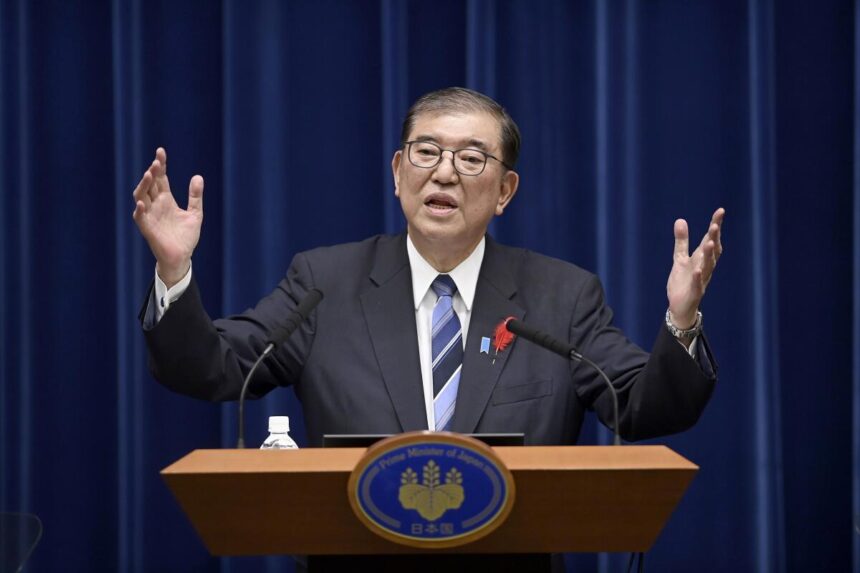
Japan’s newly appointed Prime Minister, Shigeru Ishiba, has proposed a NATO-style nuclear-sharing agreement with the United States to enhance deterrence against regional threats posed by China, North Korea, and Russia. He has advocated for the establishment of a “Asian NATO,” a regional defence alliance founded on the principles of mutual defence, akin to NATO in Europe. Ishiba’s idea arises amidst escalating geopolitical tensions in the Asia-Pacific, and he contends that such an alliance is essential to confront the increasing military might of these nations.

Ishiba’s proposals have incited considerable controversy, especially as they contest Japan’s enduring post-World War II nuclear policies. For decades, Japan has maintained the “Three Non-Nuclear Principles,” which forbid the possession, development, and introduction of nuclear weapons within its territory. These principles were established following the destruction wrought by the atomic bombings of Hiroshima and Nagasaki and have since influenced Japan’s pacifist position.

Nonetheless, Ishiba contends that the conventional U.S. extended deterrence, which entails the provision of nuclear protection to its regional allies, may no longer adequately meet the evolving security landscape in Asia. He cites the expanding military cooperation between Russia and North Korea, together with China’s swiftly modernizing nuclear arsenal, as justifications for the necessity of a more direct nuclear-sharing agreement. Ishiba’s proposal for a “Asian NATO” highlights the need he perceives in establishing a regional collective defence system.

This plan, however, may have extensive ramifications. On one hand, it may enhance regional security by offering a more formidable deterrent against rivals, so diminishing the probability of aggression from North Korea or China. Conversely, it poses a risk of heightening tensions with China, which is already apprehensive about Japan’s growing military capabilities and its partnership with the United States. Beijing may perceive this action as a direct challenge to its strategic interests, potentially resulting in an arms race or further militarization of the Asia-Pacific area.

The domestic reaction to Ishiba’s suggestions has been varied. Some conservative elements within Japan’s government advocate for a more robust defence posture, while others express apprehension regarding possible public backlash, given the historical opposition of the Japanese populace to nuclear weapons stemming from the nation’s distinct experience with atomic warfare. Moreover, Japan’s pacifist constitution, which constrains the functions of its Self-Defense Forces, may present legal obstacles to enacting such a substantial alteration in defence policy.

Moreover, Ishiba’s suggestion for a “Asian NATO” prompts inquiries on the operational dynamics of such an alliance, considering the varied political and security objectives of regional nations. In contrast to Europe, where NATO functions well as a collective defence entity, Asia exhibits a deficiency in coherence among its states. Countries such as South Korea, Australia, and India may serve as pivotal candidates for an alliance; yet, their individual bilateral relations with China and the U.S. could hinder the establishment of a cohesive defence bloc.

Notwithstanding these hurdles, Ishiba’s plan signifies an increasing acknowledgment in Japan of the necessity for a more proactive defence posture, particularly as China perpetuates its military expansion in the region. The ascendance of China as a global power, coupled with the nuclear threats from North Korea and the strong military alliance between Moscow and Beijing, has compelled Japan to reevaluate its defence strategies. Ishiba promotes nuclear-sharing and a regional defence alliance to secure Japan’s safety in a more dangerous geopolitical environment.

If implemented, these plans might substantially shift the power dynamics in the Asia-Pacific, positioning Japan as a more proactive participant in regional security. Nonetheless, the process of enacting such modifications is laden with diplomatic, legal, and political challenges. Ishiba’s vision for a “Asian NATO” and nuclear-sharing, regardless of its realization, signifies a substantial transformation in Japan’s defence strategy and has the potential to redefine the nation’s role in global security for the foreseeable future.

Read more here.

You Might Also Like

Salafi Consolidation: Is Iraq—and the KRG—Next After Syria and Yemen?

Great-Power Condominium or Great-Power Mirage?

This Week’s Global Fault Lines: Venezuela, Greenland, and the New Coercion (Jan 01–07, 2026)

Global Fault Lines: Weekly Developments Across Key Geopolitical Theaters (Dec 22–28, 2025)

Gaza, Not Ankara: The Real Motive Behind Israel’s Somaliland Recognition

Share This Article
Facebook Twitter Email Print
Previous Article Orbanisation: Hungary’s Political Playbook and Its Appeal to Trump-Era Republicans
Next Article China’s Expanding Naval Strategy: Increased Operations Near Japan’s Yonaguni Island
Leave a comment

Leave a Reply Cancel reply

Your email address will not be published. Required fields are marked *

Stay Connected

TwitterFollow
YoutubeSubscribe

Latest News

Erdoğan’s Self-Inflicted Airpower Wounds: How Turkey Lost the Skies
Commentary Defence Technology Geopolitics Middle East & Africa
Ahmed al-Ahmed: The Hero Islamophobes and Anti-Immigrant Voices Did Not Expect
Commentary Geopolitics Human Rights Terrorism
Eight Muslim States Warn Israel Against ‘Exit-Only’ Rafah Plan
Geopolitics Human Rights Middle East & Africa
Five Turkish defense firms enter SIPRI Top 100 with record $10.1 billion in 2024 sales
Defence Technology Geopolitics

Find Us on Socials

© GeoPolist. All Rights Reserved.
  • Submit an Op-Ed + Risk Advisory
  • Jobs
  • Post Jobs & Ads for Free
Welcome Back!

Sign in to your account

Register Lost your password?