Two weeks is a long time in geopolitics—until you see how quickly it can shrink a minister’s credibility.
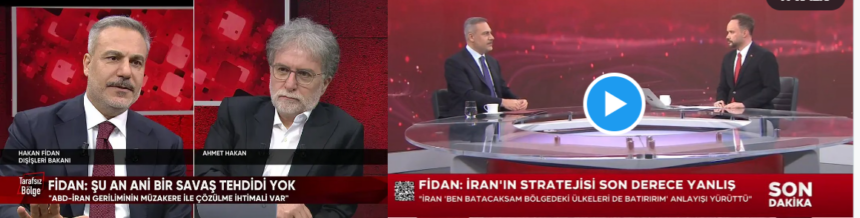
Two weeks ago, Turkey’s foreign minister was urging calm. On Feb. 9, during a live CNN Türk interview, Hakan Fidan insisted that “at least for now, there seems to be no immediate threat of war” between the U.S. and Iran. He stressed diplomacy – citing Turkey’s efforts to mediate talks in Oman – and flatly rejected any notion that Western airstrikes could bring down Iran’s government. When asked on camera if an American or Israeli bombing campaign might topple Tehran’s leadership, Fidan replied bluntly: “No, [it] will not [collapse]” and called the idea “an empty dream”. In Fidan’s telling, Iran was still very much standing and Turkish diplomacy could avert wider war.
Fast forward to early March, and the tone could not be more different. In the face of overwhelming reality, Fidan pivoted. In a special TRT Haber broadcast on March 3 – after the U.S. and Israel launched massive strikes across Iran (even killing Supreme Leader Khamenei) – Fidan began emphasizing Iran’s vulnerabilities rather than its strength. He scolded Iran for failing to prepare its own intelligence and air defenses: “If you didn’t do your homework and build up your capabilities, you shouldn’t even be debating with Israel or America at that level,” Fidan said. He lamented that Iran’s radar and defense systems had been weak (“kusursuz bir durumda [it] must be flawless to protect its airspace”), and boasted that Turkey itself had learned “serious lessons” on defense from recent conflicts. In other words, Fidan went from soothing concerns about war to essentially blaming Iran for getting hit – all in the space of a few news cycles.
He even talked about Iran’s political shake-up. He speculated that the Iranian interim leadership might be “a chance to stop the war”, implying that new voices in Tehran could favor negotiations. This is where the pivot stops looking like realism and starts looking like a sell-out. Fidan moved from protecting the regime’s durability to effectively advertising its vulnerability—speaking about Iran’s political shake-up as an opportunity.
The pivot was not only substantial; it also pertained to crisis communications. For approximately four days after the war began, Fidan was absent from the public eye, and attention shifted to his deputy. This deputy appeared on Al Jazeera as international interest in the conflict with Iran grew. However, the interview attracted criticism for its delivery. The presentation came across as less of a carefully coordinated, strategically crafted message and more like an unsteady performance, characterized by limited rhetorical control and a lack of linguistic fluency that such a platform typically expects.
Fidan’s abrupt flip has not gone unnoticed. Domestically, the U-turn has fueled criticism of the AKP government. Opposition MPs accuse Ankara of “not seeing” the war coming despite mounting signs. Internationally, allies and neighbors will wonder which version of Fidan’s Turkey to trust. Is Ankara really betting on a negotiated settlement, or is it quietly aligning with the U.S./Israel position now?
In parliament on the same day, opposition CHP leader Özgür Özel mocked Fidan’s earlier optimism. “Two weeks ago Fidan was saying ‘no threat of war’, but now rockets are falling everywhere,” Özel quipped. The meme potential quickly spread on social media: Turkish commentators pointed out that on Feb. 9, Fidan even dismissed war talk as “just talk” during his CNN interview. When reality careened into war, his message did a 180.
The self-preservation angle
Fidan’s pivot reads less like a message to Tehran than a survival maneuver aimed at Ankara. In the palace ecosystem, perception is power—especially in succession politics. Speculation about Erdoğan’s eventual successor has long circulated in the media, and Fidan’s name has periodically appeared on those lists. Whether or not those lists are serious is beside the point: in Erdoğan’s system, being discussed as a potential pole is itself a political condition—one that makes reputation, competence, and “indispensability” existential.
That is precisely why Iran’s weakening—or even the possibility of regime fracture—creates a toxic problem for an official widely suspected as Tehran’s key intelligence-linked asset in Turkey. If his Iranian networks are exposed, if Tehran looks shakier than the “won’t collapse” confidence he projected on Feb. 9, then proximity to Iran stops looking like strategic depth and starts looking like political contamination.
A former spymaster understands this instinct better than anyone. When a partner becomes compromised, the first move in politics is not sentiment—it is distance, insulation, and narrative control. That is why his tone hardens into separation. That is why “Iran will not collapse” morphs into “Iran didn’t do its homework.” It is not merely analysis; it is repositioning—an attempt to switch sides of the story before the story switches on him.
And on Ankara’s internal chessboard, the risk multiplies. Fidan’s vulnerability is not only external; it is domestic. The “Bilal Erdoğan factor”—the gravitational pull of dynastic succession talk—has already created headwinds for anyone viewed as an alternative pole. In such an environment, any public misread is not simply a misread; it becomes ammunition.
Hakan Fidan—widely seen by his detractors as Iran’s most consequential intelligence asset/operative inside Turkey—was already vulnerable in the succession game because of the “Bilal Erdoğan factor.” Now the headwinds are stronger, the Iran file is more radioactive, and his days in office look even more numbered.
Bottom line
Turkey’s strategic interest—avoiding a regional inferno—might not have changed. But Fidan’s personal-risk environment has.
The February Fidan spoke like a mediator confident he could slow history. The March Fidan speaks like an inspector writing the after-action report—and assigning responsibility. Thus, Fidan is trapped between two public images he created himself. In February, he was the confident mediator, signaling that war was not imminent and that Tehran would not collapse from airstrikes. In March, he is the stern critic, telling the region that Iran’s strategy is disastrously wrong and that Iran lacked the preparedness to even posture against Israel and the United States.
For now, Fidan is trying to outrun his own words. And the problem with outrunning your own words is that the record is faster than you are.
By: GEOPOLIST – Istanbul Center for Geopolitics