Turkey is still saying it is not a party to the war around Iran. In formal terms, that is true. Ankara has not joined the fighting, and President Recep Tayyip Erdoğan has warned that the conflict must stop before the whole region is pulled in. But three missile-related incidents in ten days have made Turkey’s position much harder to describe as simple detachment. On March 4, March 9 and March 13, Turkey said projectiles launched from Iran entered or approached Turkish airspace and were intercepted by NATO air and missile defense assets. Iran denied targeting Turkey and called for a joint technical investigation, but the pattern itself has changed the debate. The question is no longer only whether Turkey wants to stay out. It is whether the war is beginning to treat Turkey as part of its operational map.
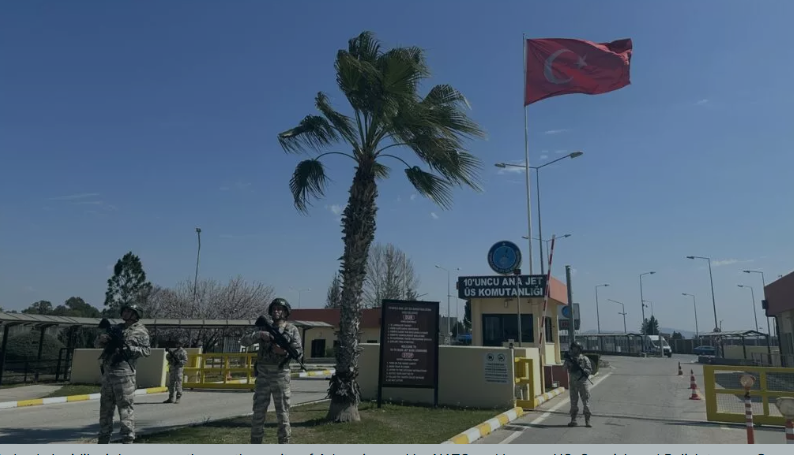
The third incident was especially difficult for Ankara to politically contain. The latest incident was serious enough that an explosion was heard near Incirlik in Adana province and that windows shook in the area. Turkey did not say what the projectile was targeting, and there is still no public evidence proving that Incirlik itself was the intended destination. Even so, the third interception to the vicinity of one of Turkey’s most sensitive military sites have pushed the crisis into a more immediate and politically charged arena, as Turkish and allied personnel remain stationed there at a moment when every nearby blast is viewed through the lens of escalation.
A day before the latest incident, Turkey’s Defense Ministry had taken care to stress that Incirlik is a Turkish base under Turkish command, not an American base simply because U.S. forces are present there. The fact that the incident came right after Ankara’s statement inevitably invites suspicion. It may have been an Iranian message, a battlefield error, or a provocation by forces that want to drag Turkey into the war.
Tehran has tried to push back against that interpretation. The Iranian embassy in Ankara said no projectile had been launched from Iran toward Turkey and proposed a joint investigative mechanism. That position broadly aligns with what Iranian officials told Turkish counterparts earlier in the week regarding the first two projectiles.
What makes this more than a bilateral Turkish-Iranian dispute is the broader pattern now emerging across the region. At least five French soldiers were wounded and one was killed in a drone attack on a joint Peshmerga-French base in Iraq’s Makhmour region. In a separate incident, one of Italy’s bases in Erbil was also hit by a drone strike, causing material damage. At the same time, three commercial vessels were struck by unidentified projectiles in or near the Strait of Hormuz on March 11, adding to a growing number of attacks on shipping since the conflict began. Iran’s military has also warned that ships linked to the United States, Israel, or their allies could be treated as legitimate targets. Taken together, these developments point to something far more serious than accidental spillover. They suggest a conflict that is increasingly placing NATO-linked personnel, Western military positions, and international shipping lanes under simultaneous pressure.
Seen in that context, Turkey’s missile scares no longer look like isolated episodes. They look like part of a widening pressure campaign around Western and allied infrastructure. Turkey’s geography makes it especially vulnerable to that dynamic. Incirlik in Adana and Kürecik in Malatya are not peripheral facilities. They are part of the military architecture through which NATO watches, warns and, if necessary, responds. It has also been reported that a U.S. Patriot system is being deployed to Malatya near the Kürecik radar base, which helped identify earlier incoming missiles, while Turkish broadcasters have separately shown Patriot components being transported there for installation
That is why the military debate inside Turkey has become far more uncomfortable. After years of political controversy and billions of dollars spent, why are the S-400s not the systems now shaping the public’s sense of security? Their purchase not only led to Turkey’s expulsion from the lucrative and strategically significant F-35 program, but also deepened the strain on the Turkish Air Force, leaving it heavily dependent on aging F-16s. The Defense Ministry has said the S-400s were not used because NATO’s integrated air-defense network was faster and more effective. That may be a valid technical explanation, but it also exposes an awkward political reality: when Turkey faced repeated ballistic threats, the shield that mattered was NATO’s network, not Turkey’s most controversial sovereign defense acquisition. Despite its defense-industrial advances and its status as NATO’s second-largest army, Turkey still lacks a fully developed national air-defense architecture and has therefore had to rely on allied systems in moments of real danger.
That gap between rhetoric and reality matters because Turkey has spent years presenting itself as a power that can balance between blocs while preserving strategic autonomy. There is some truth to that self-image. Turkey has a large military, a growing defense industry and a foreign policy that tries to keep channels open to Washington, Moscow, Beijing and the Gulf at the same time. Yet the current crisis is showing the limits of that posture. A country can be militarily significant and still remain operationally dependent in one critical domain. Ballistic missile defense is proving to be that domain. Turkey can still say it is not in the war, but it is increasingly relying on NATO assets to prevent the war from reaching deeper into its territory.
The government’s own rhetoric suggests that it understands how delicate the situation has become. Erdoğan has said the war must end before it drags the entire region into a wider conflict, a line that reflects both concern and political caution. At the same time, Foreign Minister Hakan Fidan and the Defense Ministry have adopted a tougher tone, while Turkish security sources speaking to international news outlets have warned that restraint should not be mistaken for unlimited tolerance. In this sense, this week’s visit by Turkey’s Land Forces Commander, General Metin Tokel, to Nakhchivan is particularly significant. During the visit, he publicly stated that Turkey was ready to provide Azerbaijan with military assistance under the Shusha Declaration. The declaration commits Ankara and Baku to consultations and necessary support if either faces a threat or aggression from a third state.
Whether this contrast reflects a deliberate good-cop, bad-cop division of labor or simply a distribution of roles in a moment of crisis remains unclear, but it gives Ankara room to warn and deter without yet fully committing itself to escalation.
There is also a domestic political reason this matters. Turkey’s economy is still under strain from tight monetary policy, persistent inflation and a prolonged manufacturing slowdown. High interest rates have hurt exporters and industrial firms, manufacturing has shed hundreds of thousands of jobs in recent years, and contraction has continued into 2026. Erdoğan, meanwhile, faces a more difficult political landscape. Despite his imprisonment, Ekrem İmamoğlu remains one of the most serious opposition figures, while Mansur Yavaş is also seen as a strong potential challenger. Polls continue to show the opposition as competitive, and opposition leaders openly suspect that Erdoğan may seek an early election in 2027 to preserve his room to run again. Against this backdrop, it is reasonable to argue that either prolonged wartime conditions or a short, victorious conflict could work to the government’s advantage. Such a scenario could push economic distress out of the spotlight, strengthen the hand of the security establishment, elevate the rhetoric of sovereignty and national survival, and create a more controlled political climate for regime consolidation, possibly even paving the way for a dynastic succession in which Bilal Erdoğan could emerge as a candidate in 2028 or in subsequent elections. In that sense, even if Erdoğan himself sounds cautious, a drawn-out regional crisis could still serve the broader interests of a ruling system confronting both economic fatigue and growing speculation over succession.
There is also an international dimension to this. In December 2024, Donald Trump praised Turkey as a country that had built a “very strong, powerful army” that had “not been worn out by war,” casting Ankara as a major regional force. That makes the present picture more revealing. As elections approach in the United States, the deaths of U.S. ground troops would carry serious political costs for Trump, whereas losses suffered by allied ground forces or proxy groups would be far less damaging to him domestically.
The timing of the Halkbank decision also matters. On March 9, U.S. prosecutors reached a deferred prosecution agreement with Halkbank that could ultimately end one of the most politically sensitive disputes between Ankara and Washington, and by March 11 the judge had paused the case for 90 days to allow the agreement to take effect. The deal requires compliance monitoring and tighter sanctions controls, but it includes no financial penalty and was explicitly justified in court filings by “national security and foreign policy” considerations. In the current context, that timing is hard to ignore.
So, is Turkey, along with NATO, being dragged into war with Iran? Not in the legal sense, at least not yet. Turkey has not become a declared belligerent, and both Ankara and Tehran are still speaking the language of caution, clarification and investigation. Yet the fog surrounding these incidents is itself becoming part of the danger. Iran insists the projectiles were not fired at Turkey and has proposed a joint investigation, while some circles in Ankara continue to maintain that they came from Iran. In that kind of environment, future escalations may not always be clear-cut. Some may indeed originate from Iran; others could result from miscalculation, misattribution, or provocations later blamed on Tehran. The latest case already shows how risky that ambiguity can be. Turkey has not publicly identified the projectile’s destination, but the interception came late enough for an explosion to be heard near Incirlik, suggesting that the potential for miscalculation, manipulation, or politically useful attribution is growing.
In practical terms, then, the answer is moving closer to yes. When projectiles linked by Ankara to the conflict enter or approach Turkish airspace three times in ten days, when allied missile defenses on Turkish territory are being reinforced, when Italian and French positions in northern Iraq come under attack, and when shipping lanes in Hormuz are already under mounting pressure, the line between being outside a war and being increasingly shaped by it begins to erode.
Turkey also has options short of direct war, and Ankara knows it. If the crisis deepens, Erdoğan would not necessarily need to deploy large Turkish ground forces to become more deeply involved. Ankara has a record of projecting influence through partner forces and aligned armed networks, most clearly in Syria and Libya, and also during the 2020 Nagorno-Karabakh war. In other words, if Turkey were ever to move into a broader anti-Iran alignment, that shift might not begin with a formal declaration of war. It could emerge instead through allied militaries, indirect deployments, intelligence coordination, logistical support, or deniable force multipliers.
By: GEOPOLIST – Istanbul Center for Geopolitics