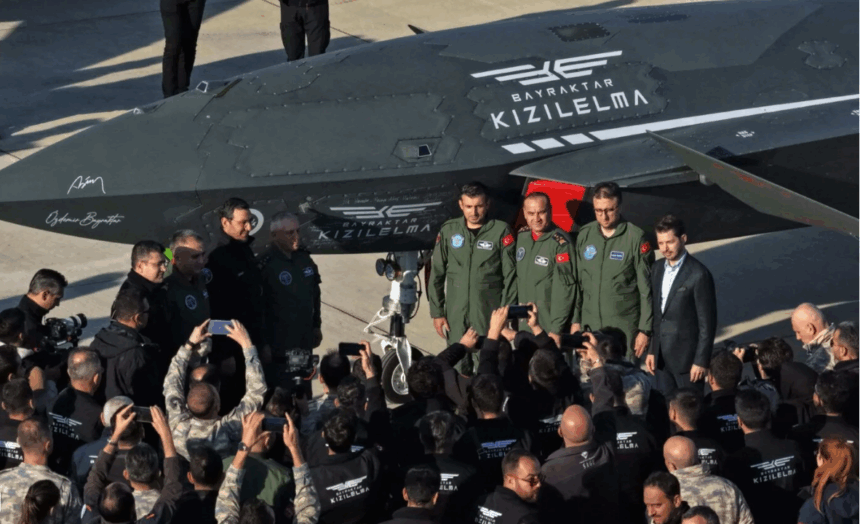
Turkey’s jet-powered combat drone Bayraktar Kızılelma has struck a jet-powered aerial target with a radar-guided, beyond-visual-range air-to-air missile during a test over the Black Sea, in what its manufacturer says is a first for unmanned aviation.
Baykar Technologies, the Istanbul-based company that developed the aircraft, said on Sunday that the unmanned fighter conducted the live-fire trial on Saturday off the coast of Sinop in northern Turkey. The company said Kızılelma detected, tracked and engaged a high-speed target drone outside the operator’s line of sight using its own onboard radar.
According to Baykar and Turkish defence officials, the test marked the first time a jet-powered unmanned combat aircraft has destroyed a jet-engine-powered target using a beyond-visual-range air-to-air missile. Independent confirmation of that claim was not immediately available.
During the exercise, a jet-powered target drone was launched over the Black Sea. Baykar said the Kızılelma used its nose-mounted MURAD 100-A active electronically scanned array (AESA) radar, developed by Turkish defence electronics firm Aselsan, to search for, identify and track the target. Once a firing solution was calculated, the drone launched a Gökdoğan beyond-visual-range missile from one of its underwing hardpoints.
Gökdoğan, produced by TÜBİTAK SAGE, the defence research arm of Turkey’s scientific council, is an indigenous beyond-visual-range air-to-air missile developed under the GÖKTUĞ programme and intended to replace imported AIM-120 AMRAAM missiles in Turkish service. Baykar said the missile hit the target with “full accuracy,” and video released by the company appears to show a direct impact.
Baykar and Turkish officials have highlighted the test as demonstrating a fully domestic air-to-air “kill chain,” with the airframe, radar and missile all designed and produced in Turkey. It was also the first time, officials said, that a Turkish-built aircraft fired a domestically produced air-to-air missile at an airborne target under guidance from a Turkish-made radar.
The mission also tested manned–unmanned teaming concepts. Five Turkish Air Force F-16 fighter jets took off from Merzifon’s 5th Main Jet Base Command and rendezvoused with Kızılelma over the test area, flying in formation with the drone. A Bayraktar Akıncı unmanned aircraft operated nearby to record the flight and provide additional data. Baykar said senior Turkish Air Force commanders and company executives, including chief technology officer Selçuk Bayraktar, observed the test from the cockpits of the F-16s.
Bayraktar said in a social media post that the engagement “opened a new chapter in aviation history,” describing Kızılelma as a project that the company had pursued for more than a decade. He said the test showed that unmanned aircraft could assume some air-to-air roles traditionally carried out by crewed fighters.
Kızılelma, whose name means “Red Apple” in Turkish, is Turkey’s first jet-powered, low-observable unmanned combat aircraft. Developed as part of Baykar’s MIUS (Combat Unmanned Aircraft System) programme, it completed its maiden flight in late 2022 and has since been undergoing phased testing. Turkish officials say the platform is designed to operate alongside F-16s and, in future, the TF Kaan next-generation fighter, performing missions including air patrol, escort and precision strike.
The aircraft is also being marketed as compatible with short-runway or naval operations, including potential deployment from Turkey’s amphibious assault ship TCG Anadolu and a planned future aircraft carrier. Baykar has said future variants are expected to offer higher speeds and payloads than the current model.
The latest trial follows a series of earlier tests in which Kızılelma conducted simulated air-to-air engagements and air-to-ground strikes using domestically developed munitions. Defence analysts say the successful beyond-visual-range test indicates that Turkey is moving to integrate the drone into a broader indigenous air combat architecture built around national radars, missiles and command-and-control systems.
Baykar is best known internationally for its propeller-driven Bayraktar TB2 drone, which has been exported to numerous countries and used in conflicts in Ukraine, the South Caucasus, the Middle East and North Africa. Turkish officials have not yet announced when Kızılelma will enter operational service or whether it will be offered widely for export.