By using this site, you agree to the Privacy Policy and Terms of Use.
Accept
Geopolist | Istanbul Center for GeopoliticsGeopolist | Istanbul Center for GeopoliticsGeopolist | Istanbul Center for Geopolitics
  • Home
  • Geopolitics
    Geopolitics
    Discover professional insights into international relations, regional conflicts, and global power dynamics by visiting Geopolist. Keep up on the ways in which these changes impact…
    Show More
    Top News
    Operation Spiderweb: The Death of Strategic Depth in the Drone Age
    August 6, 2025
    The End of Vertical War: Operation Spiderweb and the Rise of Horizontal War-Making
    August 6, 2025
    President Ebrahim Raisi’s Death: What Are the Political and International Perspectives for the Islamic Republic of Iran?
    April 13, 2025
    Latest News
    Why Washington Cannot Afford to Leave Iran’s Regime Standing
    March 23, 2026
    Three Missiles, One Question: Is Turkey Along With NATO Being Dragged Into War With Iran?
    March 14, 2026
    Mojtaba Khamenei May Save the Regime Today—and Doom It Tomorrow
    March 11, 2026
    Wilayat al-Faqih Is Entering Its Final Chapter
    March 6, 2026
  • Security
    SecurityShow More
    Erdoğan’s Self-Inflicted Airpower Wounds: How Turkey Lost the Skies
    December 26, 2025
    Ahmed al-Ahmed: The Hero Islamophobes and Anti-Immigrant Voices Did Not Expect
    December 15, 2025
    Five Turkish defense firms enter SIPRI Top 100 with record $10.1 billion in 2024 sales
    December 1, 2025
    Turkey’s Kızılelma drone fires radar-guided missile in beyond-visual-range test
    December 1, 2025
    More Than Mischief: How a Weakened Moscow Seeks to Dismantle NATO from Within
    September 21, 2025
  • Commentary
    CommentaryShow More
    Why Washington Cannot Afford to Leave Iran’s Regime Standing
    March 23, 2026
    Three Missiles, One Question: Is Turkey Along With NATO Being Dragged Into War With Iran?
    March 14, 2026
    Mojtaba Khamenei May Save the Regime Today—and Doom It Tomorrow
    March 11, 2026
    Wilayat al-Faqih Is Entering Its Final Chapter
    March 6, 2026
    Hakan Fidan’s Two-Week U-Turn on Iran
    March 4, 2026
  • Economy
    • Energy
  • Regions
    • Europe
    • Middle East & Africa
    • Eurasia
  • Risk Advisory
  • Jobs
    • Job Dashboard
    • Jobs
    • Post a Job
  • Register
  • My Bookmarks
Reading: China’s Oil Dilemma: Navigating Dependence, Supply Risks, and the Transition to Renewables
Share
Notification Show More
Font ResizerAa
Geopolist | Istanbul Center for GeopoliticsGeopolist | Istanbul Center for Geopolitics
Font ResizerAa
  • Home
  • Geopolitics
  • Security
  • Commentary
  • Economy
  • Regions
  • Risk Advisory
  • Jobs
  • Register
  • My Bookmarks
  • Home
  • Geopolitics
  • Security
  • Commentary
  • Economy
    • Energy
  • Regions
    • Europe
    • Middle East & Africa
    • Eurasia
  • Risk Advisory
  • Jobs
    • Job Dashboard
    • Jobs
    • Post a Job
  • Register
  • My Bookmarks
Have an existing account? Sign In
Follow US
  • Advertise
© 2022 Foxiz News Network. Ruby Design Company. All Rights Reserved.
Geopolist | Istanbul Center for Geopolitics > Blog > Economy > Energy > China’s Oil Dilemma: Navigating Dependence, Supply Risks, and the Transition to Renewables
CommentaryEnergyGeopoliticsSoutheast Asia

China’s Oil Dilemma: Navigating Dependence, Supply Risks, and the Transition to Renewables

Last updated: July 28, 2024 5:39 pm
By GEOPOLIST | Istanbul Center for Geopolitics Published July 28, 2024 1.1k Views 9 Min Read
Share
SHARE

Summary by Geopolist | Istanbul Center for Geopolitics:

China faces significant challenges in meeting its growing demand for oil, driven by its rapid economic development and industrialization. As the world’s largest importer of oil, China imports about 10 million barrels per day, mainly from the Middle East, Africa, and Russia. This dependency on foreign oil makes China vulnerable to geopolitical shifts and market volatility.

China has taken several strategic steps to secure its oil supply and mitigate these risks. Firstly, it has established the National Oil Reserve to buffer against supply disruptions. Additionally, China has diversified its oil suppliers, increasing imports from countries like Brazil, the United States, and Norway. This strategy not only reduces reliance on a few sources but also leverages the competitive oil prices in different regions.

Furthermore, China is investing heavily in overseas oil fields and infrastructure projects to ensure stable and long-term access to oil. This includes significant investments in Africa and the Middle East, where Chinese companies are involved in oil extraction and pipeline construction projects. For instance, China has bankrolled the East African Crude Oil Pipeline (EACOP) project in Uganda, portraying itself as a reliable development partner amid Western investors’ retreat due to environmental concerns​.

Domestically, China is also pushing for increased production from its oil fields and exploring new technologies to enhance oil recovery rates. However, these efforts are often hampered by the technical challenges of extracting oil from mature fields and the environmental costs associated with increased production.

To address long-term sustainability and energy security, China is accelerating its transition to renewable energy. Investments in solar, wind, and hydroelectric power are expanding, and China is becoming a global leader in renewable energy technology. This shift not only aims to reduce dependency on fossil fuels but also to meet international climate commitments and address domestic pollution issues.

In summary, while China continues to grapple with its high oil demand, it is employing a multi-faceted strategy that includes diversifying suppliers, investing in international projects, enhancing domestic production, and shifting towards renewable energy to ensure its energy security and economic stability​.

Read more below.


No easy answers to China’s raging thirst for oil

Since the start of the year, CNOOC has announced two other significant discoveries and each is expected to add over 100 million tonnes of oil equivalent – one in the deepwater Kaiping South oilfield in the Pearl River Delta, near Guangdong province, and the other in the Qinhuangdao oilfield in the Bohai Sea.

These reflect China’s push in recent years to tap more deepwater oil as its onshore oilfields mature and near the end of their productive life. Last year, China produced 208 million tonnes of crude oil – a robust 4.18 million barrels per day (bpd), but still below the 2015 record of 4.3 million bpd.

Though it surprises some, China ranks among the world’s largest producers of crude oil. Last year, it came in at sixth place, after the United States, Russia, Saudi Arabia, Canada and Iraq. But this considerable output is still not enough to meet China’s insatiable thirst.

02:10

China starts drilling second 10,000-metre hole in search of oil and natural gas

China starts drilling second 10,000-metre hole in search of oil and natural gas

China remains the world’s largest crude oil importer, taking in 11.3 million bpd last year, a 10 per cent increase over the previous year, according to Chinese customs data. This over-reliance on crude oil imports, mostly from the Middle East, keeps the country’s foreign oil dependency at precarious levels. At the same time, the options to ramp up domestic oil production are limited.

Thus, it continues to develop offshore oil resources despite the inherent dangers. Offshore drilling comes with greater environmental risks and a score of technical issues, along with the need to grapple with remote and harsh deepwater conditions.
Last December, China launched the drilling ship Mengxiang for ultra-deep-sea operations. The ship’s drilling power has been described as top of the line – it can reach 10.94km below the sea’s surface, which is no small feat. But there is a caveat.

Drilling for oil and gas in ultra-deep waters can cost hundreds of thousands of dollars a day, substantially driving up production costs. In China, such costs sometimes have to be absorbed by the oil companies instead of being passed on to consumers, thus eating into profits. Moreover, during lower global oil price cycles, high production costs are a disincentive for production.

It will not be a surprise that major oil companies prefer cheaper ways to explore for, extract and produce hydrocarbons. At the end of the day, it is also unlikely to be China’s preferred method of oil and gas development.
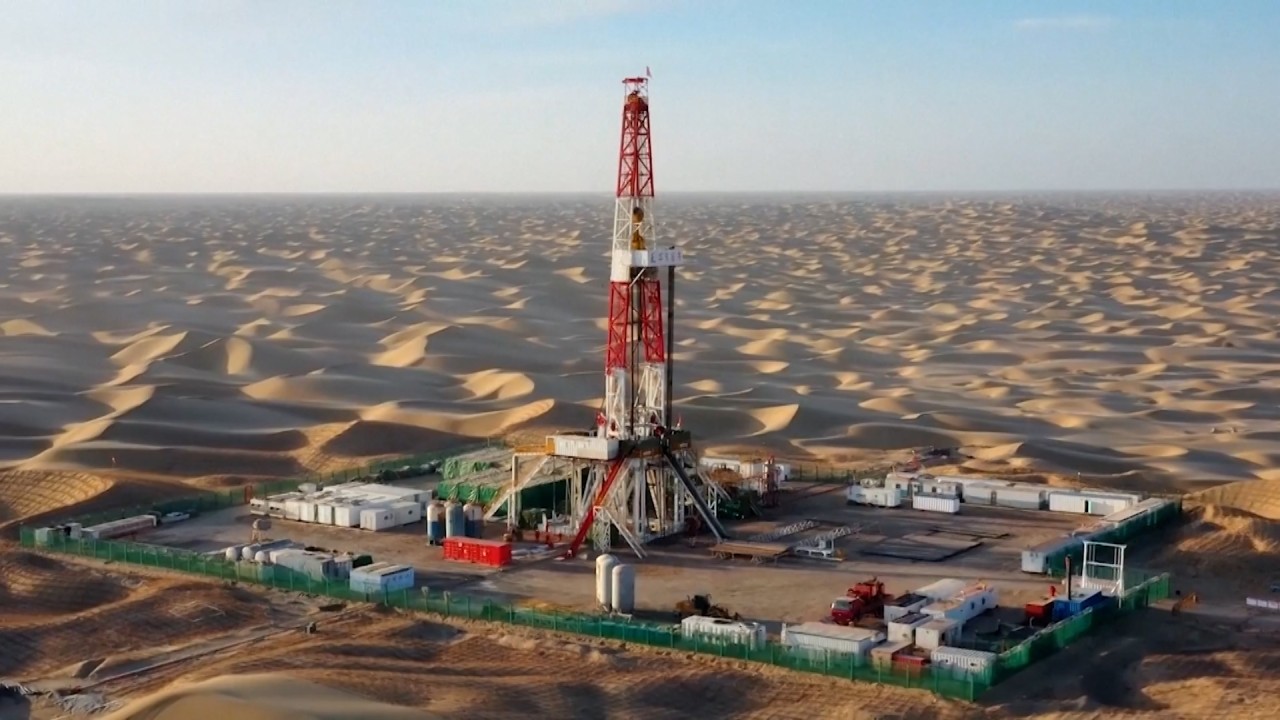
01:07

Energy giant Sinopec says new oil and gas deposits found in China’s western Xinjiang region

Energy giant Sinopec says new oil and gas deposits found in China’s western Xinjiang region

China is also trying to jump-start its shale oil and gas sector, watching the US – perhaps with some resentment – morph over the past 10 years to become the world’s top crude oil producer and liquefied natural gas (LNG) exporter due to its shale oil revolution. As result, the US has become a major seller of LNG to China, in a dicey game of geopolitical brinkmanship that has yet to fully play out.
However, the difference between the shale formations in the US and China could not be more acute. China’s shale formations are usually deeper, harder to develop and more varied. The Chinese shale sector also faces the challenge of inadequate infrastructure in the remote mountainous areas where most of the country’s shale resources lie, making it harder to find and identify the exploration sweet spots. China’s shale formations also hold heavier, waxy oils that are more difficult to recover.

To help offset these hurdles, China’s energy sector has called for more support from the central government. In March, Ma Yongsheng, chairman of state-run China Petroleum & Chemical Corporation (Sinopec), China’s largest energy company, noted that even though China has abundant shale oil reserves, extraction is more complex than in the US due to geological constraints. The government should boost financial support for research and development for the drilling and extraction of shale resources, he added.

There is simply no easy answer for Chinese government energy planners who need to find ways to increase oil production.

Some analysts are projecting a slowdown in China’s oil demand growth, and that should help alleviate the supply problem. Risk consultancy Eurasia Group says that China is unlikely to return to the pre-Covid-19 model of oil-intensive economic growth, and projects the country’s incremental demand at about 250,000-350,000 bpd of oil this year, less than half of the 2019 growth level.

That may be welcome news for China but the country’s appetite for oil is still expected to grow, albeit not as quickly. China will remain the world’s largest crude oil importer for now. To rid itself of its oil habit – and correspondingly high carbon dioxide emissions – China needs to go further than slowing down oil demand growth. It needs its oil use to drop significantly. But, for that to happen, the country has a lot more difficult work ahead.

By: Tim Daiss

Source: South China Morning Post

You Might Also Like

Why Washington Cannot Afford to Leave Iran’s Regime Standing

Three Missiles, One Question: Is Turkey Along With NATO Being Dragged Into War With Iran?

Mojtaba Khamenei May Save the Regime Today—and Doom It Tomorrow

Wilayat al-Faqih Is Entering Its Final Chapter

Hakan Fidan’s Two-Week U-Turn on Iran

Share This Article
Facebook Twitter Email Print
Previous Article NATO’s New Map – Foreign Policy NATO’s Arctic Strategy: Nordic Nations’ Integration Bolsters Defense Against Russian Threats
Next Article India’s Democracy Under Modi: From Secularism to Hindu Nationalism and Political Repression
Leave a comment

Leave a Reply Cancel reply

Your email address will not be published. Required fields are marked *

Stay Connected

TwitterFollow
YoutubeSubscribe

Latest News

Full Compartmentalization? Assessing the Future Trajectory of Indo–Bangladeshi Relations
Commentary Geopolitics Southeast Asia
The Collapse of the Regime in Iran Could Be Ankara’s Biggest Strategic Gain Since the Collapse of the USSR
Commentary Eurasia Geopolitics Middle East & Africa
A New Order Without a Vision: The Arab World’s Missing Strategy
Commentary Geopolitics Middle East & Africa
Good Cop, Bad Cop: How Trump’s Team Pressures NATO Allies
Commentary Europe Geopolitics

Find Us on Socials

© GeoPolist. All Rights Reserved.
  • Submit an Op-Ed + Risk Advisory
  • Jobs
  • Post Jobs & Ads for Free
Welcome Back!

Sign in to your account

Register Lost your password?