By using this site, you agree to the Privacy Policy and Terms of Use.
Accept
Geopolist | Istanbul Center for GeopoliticsGeopolist | Istanbul Center for GeopoliticsGeopolist | Istanbul Center for Geopolitics
  • Home
  • Geopolitics
    Geopolitics
    Discover professional insights into international relations, regional conflicts, and global power dynamics by visiting Geopolist. Keep up on the ways in which these changes impact…
    Show More
    Top News
    Operation Spiderweb: The Death of Strategic Depth in the Drone Age
    August 6, 2025
    The End of Vertical War: Operation Spiderweb and the Rise of Horizontal War-Making
    August 6, 2025
    City on a Hill in Ashes? American Leadership in the Next Administration
    April 13, 2025
    Latest News
    Great-Power Condominium or Great-Power Mirage?
    January 12, 2026
    This Week’s Global Fault Lines: Venezuela, Greenland, and the New Coercion (Jan 01–07, 2026)
    January 8, 2026
    Global Fault Lines: Weekly Developments Across Key Geopolitical Theaters (Dec 22–28, 2025)
    December 29, 2025
    Gaza, Not Ankara: The Real Motive Behind Israel’s Somaliland Recognition
    December 27, 2025
  • Security
    SecurityShow More
    Erdoğan’s Self-Inflicted Airpower Wounds: How Turkey Lost the Skies
    December 26, 2025
    Ahmed al-Ahmed: The Hero Islamophobes and Anti-Immigrant Voices Did Not Expect
    December 15, 2025
    Five Turkish defense firms enter SIPRI Top 100 with record $10.1 billion in 2024 sales
    December 1, 2025
    Turkey’s Kızılelma drone fires radar-guided missile in beyond-visual-range test
    December 1, 2025
    More Than Mischief: How a Weakened Moscow Seeks to Dismantle NATO from Within
    September 21, 2025
  • Commentary
    CommentaryShow More
    Great-Power Condominium or Great-Power Mirage?
    January 12, 2026
    Gaza, Not Ankara: The Real Motive Behind Israel’s Somaliland Recognition
    December 27, 2025
    Erdoğan’s Self-Inflicted Airpower Wounds: How Turkey Lost the Skies
    December 26, 2025
    Ahmed al-Ahmed: The Hero Islamophobes and Anti-Immigrant Voices Did Not Expect
    December 15, 2025
    TUAF543: Accident at FL240—or a Message to Ankara?
    November 12, 2025
  • Economy
    • Energy
  • Regions
    • Europe
    • Middle East & Africa
    • Eurasia
  • Risk Advisory
  • Jobs
    • Job Dashboard
    • Jobs
    • Post a Job
  • Register
  • My Bookmarks
Reading: Egypt Seeks U.S. Support to Block Turkey-Libya Maritime Deal Amid Shifting Eastern Mediterranean Dynamics
Share
Notification Show More
Font ResizerAa
Geopolist | Istanbul Center for GeopoliticsGeopolist | Istanbul Center for Geopolitics
Font ResizerAa
  • Home
  • Geopolitics
  • Security
  • Commentary
  • Economy
  • Regions
  • Risk Advisory
  • Jobs
  • Register
  • My Bookmarks
  • Home
  • Geopolitics
  • Security
  • Commentary
  • Economy
    • Energy
  • Regions
    • Europe
    • Middle East & Africa
    • Eurasia
  • Risk Advisory
  • Jobs
    • Job Dashboard
    • Jobs
    • Post a Job
  • Register
  • My Bookmarks
Have an existing account? Sign In
Follow US
  • Advertise
© 2022 Foxiz News Network. Ruby Design Company. All Rights Reserved.
Geopolist | Istanbul Center for Geopolitics > Blog > Regions > Middle East & Africa > Egypt Seeks U.S. Support to Block Turkey-Libya Maritime Deal Amid Shifting Eastern Mediterranean Dynamics
GeopoliticsMiddle East & Africa

Egypt Seeks U.S. Support to Block Turkey-Libya Maritime Deal Amid Shifting Eastern Mediterranean Dynamics

Last updated: August 6, 2025 3:05 pm
By GEOPOLIST | Istanbul Center for Geopolitics Published July 4, 2025 711 Views 4 Min Read
Share
SHARE

Egypt has requested U.S. intervention to help prevent Libya’s eastern-based parliament from ratifying a controversial maritime agreement with Turkey, amid growing concerns that the move could escalate tensions in the Eastern Mediterranean.

According to regional officials familiar with the matter, Egyptian Foreign Minister Badr Abdelatty raised the issue in a recent phone call with Massad Boulos, the White House senior adviser for African affairs. The Egyptian side expressed concern that formal ratification of the 2019 maritime agreement—originally signed by Libya’s former internationally recognized government in Tripoli—could heighten regional disputes over energy rights and maritime boundaries. Boulos reportedly agreed to contact Khalifa Haftar, the military commander who holds de facto control over eastern Libya.

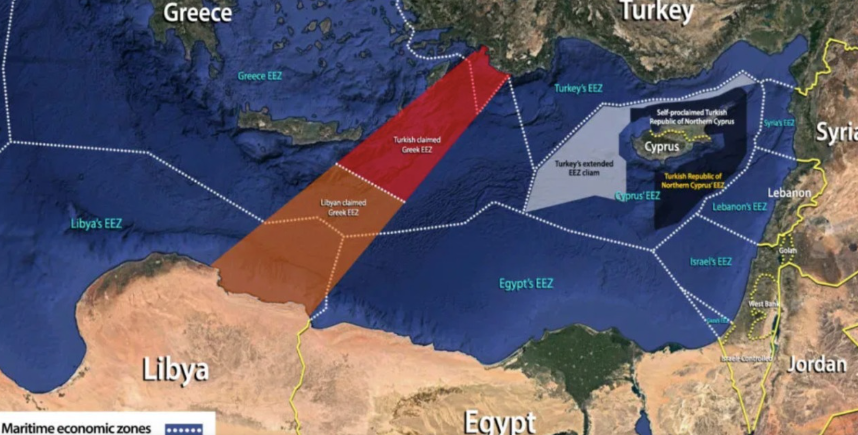
The agreement defines an Exclusive Economic Zone (EEZ) stretching between Turkey and western Libya, effectively extending Ankara’s maritime claims deep into the Eastern Mediterranean. It has drawn sharp objections from Greece, Egypt, and Cyprus, who argue that it disregards their maritime entitlements, particularly those of Greek islands. In response, Greece and Egypt signed their own EEZ agreement in 2020.

Libya’s eastern parliament, based in Tobruk and aligned with Haftar’s Libyan National Army (LNA), previously rejected the deal. However, recent reports suggest the body may be preparing to ratify it in the coming weeks. Greek Foreign Minister George Gerapetritis is expected to visit both Tripoli and Benghazi in the days ahead to address the maritime dispute with Libyan officials.

In addition to the diplomatic efforts, energy developments have further complicated the situation. In June, Libya’s National Oil Corporation, headquartered in Tripoli, signed a deal with Turkey’s state-owned energy company TPAO to conduct hydrocarbon exploration in four maritime blocks. Egyptian officials have expressed concern that some of the blocks may encroach on Egypt’s EEZ.

The apparent shift in Eastern Libya’s stance toward the Turkey-Libya maritime deal is seen as part of a broader regional realignment. Longstanding ideological divides that once defined post-Arab Spring alliances have been gradually replaced by pragmatic cooperation. Despite years of opposition, including armed conflict between Turkish-backed forces and the LNA, recent months have seen increased contact between Ankara and Haftar’s camp.

In May, Saddam Haftar—the youngest son of Khalifa Haftar—visited Ankara, following earlier trips to Qatar and Washington. In June, Turkey’s Ministry of Defense hosted three delegations from the LNA for discussions, signaling a growing willingness to engage. These developments have been closely watched in Cairo, where officials are wary of losing influence in eastern Libya.

There are also reports suggesting that Egypt views Saddam Haftar’s forces as possibly involved in cross-border activity into Sudan, and as having provided support to the Rapid Support Forces (RSF), which are currently engaged in conflict with the Sudanese military. Egypt and Turkey, despite their differing roles in Libya, have both publicly supported the Sudanese army in its confrontation with the RSF.

Earlier this week, Egyptian President Abdel Fattah el-Sisi hosted Khalifa and Saddam Haftar in El Alamein to discuss border security and regional coordination. Egypt shares a 1,115-kilometer border with Libya and considers the stability of its western neighbor a national security priority.

Although Libya remains politically divided between eastern and western authorities, major combat operations have subsided in recent years. Nevertheless, a formal ratification of the 2019 Turkey-Libya maritime deal could introduce new strains in regional diplomacy and affect energy cooperation in the Eastern Mediterranean.

The evolving situation highlights shifting regional alliances and underscores the growing complexity of maritime and geopolitical negotiations across the Mediterranean basin.


You Might Also Like

Great-Power Condominium or Great-Power Mirage?

This Week’s Global Fault Lines: Venezuela, Greenland, and the New Coercion (Jan 01–07, 2026)

Global Fault Lines: Weekly Developments Across Key Geopolitical Theaters (Dec 22–28, 2025)

Gaza, Not Ankara: The Real Motive Behind Israel’s Somaliland Recognition

Erdoğan’s Self-Inflicted Airpower Wounds: How Turkey Lost the Skies

Share This Article
Facebook Twitter Email Print
Previous Article The Zangezur Pivot: How the U.S. Is Supplanting Russia in the Caucasus
Next Article Disorder in Order: Mapping Contours of Global Geopolitical Flux

Stay Connected

TwitterFollow
YoutubeSubscribe

Latest News

Ahmed al-Ahmed: The Hero Islamophobes and Anti-Immigrant Voices Did Not Expect
Commentary Geopolitics Human Rights Terrorism
Eight Muslim States Warn Israel Against ‘Exit-Only’ Rafah Plan
Geopolitics Human Rights Middle East & Africa
Five Turkish defense firms enter SIPRI Top 100 with record $10.1 billion in 2024 sales
Defence Technology Geopolitics
Turkey’s Kızılelma drone fires radar-guided missile in beyond-visual-range test
Defence Technology Geopolitics

Find Us on Socials

© GeoPolist. All Rights Reserved.
  • Submit an Op-Ed + Risk Advisory
  • Jobs
  • Post Jobs & Ads for Free
Welcome Back!

Sign in to your account

Register Lost your password?