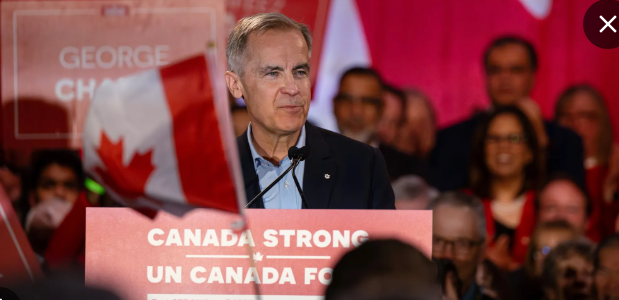
Canada has announced its intention to join ReArm Europe—a sweeping European Union initiative aimed at reviving defense capabilities and reducing dependence on U.S. military power. The move signals a historic shift in Canada’s international posture, coming just days after former U.S. President Donald Trump issued an extraordinary demand: $61 billion from Canada for participation in his proposed continental missile shield, dubbed the “Golden Dome.”
The announcement was made by Prime Minister Mark Carney in a nationally televised interview with CBC, where he argued that Canada must rethink how—and where—it spends its defense budget.
“Seventy-five cents of every Canadian defense dollar goes to the United States. That is not smart,” Carney said, criticizing what he called a decades-long pattern of funneling military resources southward.
A Diplomatic Turning Point
Trump’s ultimatum appears to have accelerated Canada’s decision. On Tuesday, he took to his platform, Truth Social, writing:
“It will cost ZERO DOLLARS if they become the 51st state we treasure.”
The post was widely interpreted as both a provocation and a challenge to Canada’s sovereignty, prompting a rare and pointed response from the Prime Minister’s Office.
“The prime minister has been clear at every opportunity, including in conversations with President Trump: Canada is an independent, sovereign country, and it will remain so,” the official statement read.
Trump’s comments, though informal, highlight a growing ideological chasm between Ottawa and Washington as Canada repositions itself geopolitically—culturally aligned with the West but increasingly wary of American unpredictability under a renewed Trump presidency.
Arctic Front and European Horizon
Canada’s foreign policy recalibration is not happening in isolation. In this week’s Throne Speech, delivered ceremonially by King Charles III during his visit to Ottawa, the government outlined a sweeping agenda for national defense modernization. The speech emphasized Arctic sovereignty as a top strategic priority amid fears of Russian militarization in the region and increased Chinese interest in Northern trade routes.
Defense Minister David McGuinty, speaking at the Halifax International Security Forum, echoed the concern:
“The global security environment is volatile and uncertain. The war in Ukraine, China’s assertiveness, and growing instability in the Arctic compel us to act—not only as a NATO ally but as a northern nation.”
Canada’s entry into ReArm Europe would align it more closely with EU nations working to strengthen collective defense in the wake of Russia’s invasion of Ukraine. The initiative—spearheaded by Brussels—aims to increase joint procurement of arms, improve defense industry resilience, and reduce the bloc’s reliance on U.S. hardware and logistics.
While Canada is not a member of the EU, its participation in ReArm Europe could be modeled after other forms of defense cooperation, such as NORDEFCO (Nordic Defense Cooperation), where non-EU members like Norway play key roles. Canadian diplomats have reportedly held talks with European Commission officials to fast-track the process.
NATO Demands and Domestic Debate
Canada’s defense shift also intersects with broader transatlantic tensions. NATO Secretary General Mark Rutte recently called on all member states to boost defense spending to 5% of GDP—a dramatic increase from the long-standing 2% benchmark. Rutte cited the emergence of a multipolar alliance between Russia, China, Iran, and North Korea as a reason to prepare for what he called “a long twilight struggle.”
This new NATO target has reignited debate in Canada about the balance between military readiness and social spending. While critics argue that Canada should resist being drawn into an arms race, supporters of increased military investment point to both security imperatives and economic opportunities.
The Canadian Chamber of Commerce has voiced its support for the defense build-up, emphasizing that greater investment could benefit domestic aerospace, cybersecurity, and artificial intelligence sectors.
“Defense spending isn’t just about tanks and missiles,” said a senior industry representative. “It’s about jobs, innovation, and building a more resilient Canadian economy.”
Between Washington and Brussels
Despite talks continuing between Ottawa and Washington regarding limited Canadian participation in the “Golden Dome” system—mainly through NORAD—Carney’s rhetoric leaves little doubt that the center of gravity is shifting eastward. For the first time in decades, Canada is openly hedging its defense bets, signaling that Washington is no longer its default military partner.
Some observers view the move as a strategic necessity. Others see it as a reflection of a deeper generational change within Canada’s political class—one that is less emotionally tethered to the U.S. and more attuned to Europe’s approach to multilateralism, climate security, and long-term strategic autonomy.
Whatever the interpretation, Canada’s decision to seek entry into ReArm Europe marks a pivotal moment in its foreign and defense policy—a conscious step away from old assumptions and toward a more diversified, assertive global role.