United States vice president J.D. Vance’s February 2026 trip to Armenia and Azerbaijan was not Washington “rediscovering” the South Caucasus; it was the operational phase of corridor statecraft—governance plus infrastructure—meant to shrink Russia and Iran’s leverage and hedge against China’s Eurasian connectivity options.
The trip is a milestone in a long-running U.S. play: build durable access corridors across the Eurasian hinge, lock in governance leverage over the connective tissue (rail, road, pipelines, fiber), and convert connectivity into strategic pressure—first on Russia, then on Iran, and, increasingly, on China.
American strategy in the region initially focused on building east–west energy routes that bypassed Russian and Iranian control. Diversification was presented as economics; it was always geopolitical. Control over export corridors meant control over leverage.
Today, that logic has expanded. The issue is no longer only who owns the pipeline. It is who sets the operating rules for transit corridors, who provides security guarantees, who manages data infrastructure, who finances upgrades, and who arbitrates disputes.
The centrepiece, TRIPP (Trump Route for International Peace and Prosperity), was launched at Donald Trump’s Aug. 8, 2025 White House summit and bureaucratized by a presidential determination directing the U.S. Department of State to establish a dedicated TRIPP working group.
The clearest evidence is that the corridor strategy is no longer rhetorical. It has been contractualized.
The corridor is now an instrument, not a slogan
The August 8, 2025 White House “peace summit” produced more than photo-ops: it anchored the corridor concept in a U.S.-brokered framework that rebrands the project as the Trump Route for International Peace and Prosperity.
Then came the operational step: the Implementation Framework signed in January 2026. This document matters because it sketches how a U.S.-backed concession could function without formally stripping Armenian sovereignty—while still embedding Washington’s presence into the corridor’s management architecture. Under the framework, the initial concession period is 49 years, extendable by 50 years (the political magic number: 99). It also outlines a revenue split (74% Armenia / 26% U.S. at the start, potentially shifting later), and it explicitly allows for private operational security personnel under Armenian licensing. Crucially, the framework is described as non-binding, which reduces legal friction now—while still creating a blueprint that can be “hardened” later through contracts, tenders, and incremental implementation.
Geography turns those clauses into strategy. The corridor runs through Syunik Province, the narrow southern slice of Armenia that separates mainland Azerbaijan from Nakhchivan—and that touches Iran’s northern frontier. That is precisely why corridor governance is never just about trade.
Vance’s February bundle: nuclear, drones, strategic partnership
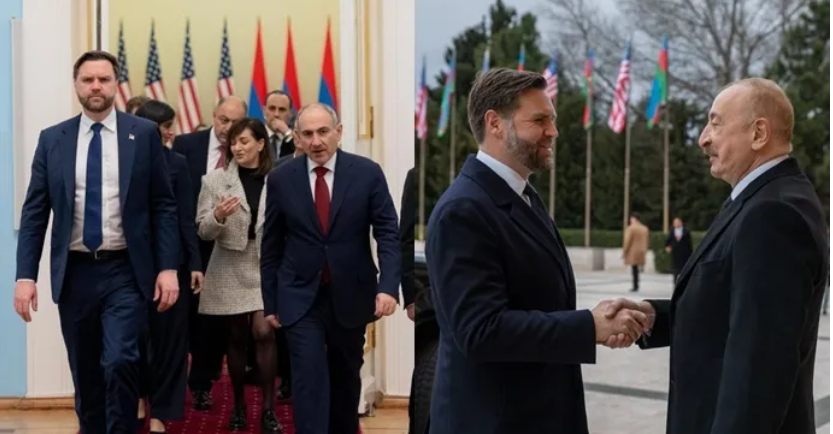
Vance landed in Armenia last Monday — a country that no sitting U.S. vice president or president has visited before. Armenia’s prime minister’s office reported that Vance and Pashinyan signed a joint statement completing negotiations on a “123” civil nuclear cooperation agreement. The package was framed as up to $5 billion in initial exports plus $4 billion in fuel and maintenance, enabling replacement of the aging Metsamor Nuclear Power Plant.
On defence, Armenian and regional reporting described a $11 million sale of V‑BAT reconnaissance drones—small in dollar terms, large in signalling, because it normalizes Western defence technology into Armenia’s security ecosystem.
The following day, Vance arrived in Baku to sign a strategic partnership with Azerbaijan’s President Ilham Aliyev. The officially published Strategic Partnership Charter—signed by Aliyev and Vance—ties cooperation to the Middle Corridor “including” TRIPP, commits to facilitating critical-minerals transit, and calls for AI partnerships and AI data-centre development, alongside expanded defence sales and cybersecurity cooperation.
The strategy behind the contract
The corridor is a means, not the end. Official readouts and leader statements consistently attach TRIPP to three overlapping U.S. objectives: geopolitical bypass, geo-economic access, and infrastructural leverage.
First is bypass. TRIPP is a 43 km/27-mile route across southern Armenia that better connects Asia to Europe while “bypassing” Russia and Iran—framing the project as an infrastructure analogue to sanctions-era supply-chain diversification. The framing is mirrored in European documents: the European Commission notes that Trans-Caspian trade has quadrupled since 2022 and positions the corridor ecosystem (rail, ports, borders, energy, digital links) as an alternative route connecting Europe and Asia as the Northern corridor becomes strategically vulnerable.
Second is access—especially to Central Asian resources and the politics of “critical minerals.” The TRIPP framework explicitly links corridor functionality to “raw materials, critical minerals, and rare earth metals” reaching American markets, and thus ties Vance’s advocacy to natural resources and minerals cooperation. That context is not abstract: China is simultaneously deepening trade, energy, minerals, and rail cooperation with Central Asian states and pushing projects like the China–Kyrgyzstan–Uzbekistan railway designed to bypass Russia and shorten China–Europe freight routes. In other words, the contest is not simply “U.S. vs Russia” but a multi-actor race to define which routes—legal, physical, and financial—become default.
Third is infrastructural leverage in the digital-industrial domain. In Armenia, Pashinyan publicly tied August 2025 U.S.–Armenia semiconductor/AI cooperation to a data-centre “megaproject” by Firebird, including U.S.-approved exports of advanced NVIDIA chips—an unusually direct coupling of diplomacy to AI compute capacity. In Azerbaijan, the strategic partnership charter text describes cooperation spanning technology, digital infrastructure, and AI, alongside trade, transit, and security cooperation.
The nuclear and defence components are the glue that turns “corridor economics” into “corridor statecraft.” In Yerevan, Vance and Pashinyan announced completion of negotiations on a U.S. “123 Agreement,” with Vance citing up to $5 billion in initial exports and an additional $4 billion in longer-term fuel/maintenance support—positioning civil nuclear cooperation as both an energy diversification tool and a geopolitical wedge away from Russia and Iran. Armenia also announced acquisition of U.S.-made V-BAT drones under a Foreign Military Sales framework, including U.S. statements referencing an $11 million sale—small in dollar terms, large in signalling value.
Russia, Iran, China: the reaction function
For Russia, TRIPP is structural loss.
First, it shifts the center of gravity of “connectivity politics” away from Moscow-controlled mechanisms toward a U.S.-designed instrument that lives on Armenian territory, under Armenian law, but with American equity and operational latitude.
Second, it exploits the reality that Russia’s bandwidth and deterrence credibility are already strained. A Russia focused on Ukraine—and on shaping the diplomatic endgame there—has fewer resources to police secondary theaters, and fewer partners willing to accept Russian tutelage as the “default setting.” This is the structural opening the corridor strategy is designed to capitalize on.
Third, it turns a former Russian “lever” (unresolved Armenia–Azerbaijan conflict) into a platform for Western institutionalization. Even if the framework remains non-binding on paper, the political effect comes from the path dependency: each contract signed, each construction segment started, each border procedure standardized makes it harder to reverse without overt confrontation.
After Vance’s visit, the Kremlin emphasized Armenia’s and Azerbaijan’s sovereign right to choose partners while stressing Russia’s willingness to compete commercially, especially on nuclear power. Moscow also pushed back hard against the prospect of a U.S.-built Armenian nuclear plant, raising seismic-safety arguments and promoting Rosatom’s advantages.
From Tehran’s perspective, a U.S.-brokered transit regime along its northern horizon is not merely a commercial project. It is strategic proximity: the corridor hugs the zone where Iran fears surveillance, influence operations, and long-term constriction of its regional mobility.
Three Iranian anxieties converge here:
- Border geometry. Syunik is Iran’s thin connective contact with Armenia. Any arrangement that feels like an externally managed strip—especially one branded, financed, and secured in ways aligned with Washington—triggers fear of gradual “strategic enclosure,” even if sovereignty remains formally Armenian.
- Security externalities. The framework’s allowance for operational security personnel and corridor-specific procedures invites a recurring Iranian suspicion: that commercial corridors can become dual-use platforms for intelligence collection and partner interoperability. Even a small footprint can feel existential if it sits in the wrong place.
- Network competition. Corridor politics compete with Iran’s own transit ambitions. If Syunik becomes the privileged route linking the Caspian/Transcaucasus to broader markets, Iran’s bargaining power as an alternative pathway declines—unless Tehran can successfully promote parallel corridors through its territory.
For China, the “tell” is the framework’s supply-chain language. In practical terms, the South Caucasus is a gate in the broader “Middle Corridor” logic that links Central Asia and the Caspian space onward to Turkey and Europe. If that gate becomes governed by Western-leaning frameworks—especially with embedded U.S. equity and security provisions—then China faces a choice: accept transit through a corridor whose governance it does not shape, or intensify investment and diplomacy to build alternatives and influence local elites.
Therefore, the corridor is less about “blocking China” outright than about standard-setting and dependency management:
- Who controls data infrastructure and digital standards along the route?
- Whose insurance, arbitration norms, compliance rules, and security practices define “normal” operations?
- Which great power becomes the ultimate problem-solver when friction emerges?
Corridor governance answers those questions. And in great-power rivalry, governance is power.
Where Turkey fits
Where does Turkey sit in this? Turkey is the indispensable regional hinge: NATO geography, energy and transport infrastructure, and deep ties with Azerbaijan and other Turkic countries under the auspices of OTS (Organization of Turkic States). For Washington, Ankara is both a partner and an instrument—useful precisely because it can expand influence while keeping the U.S. footprint politically deniable or commercially framed.
Ankara benefits from diminished Russian and Iranian leverage in the South Caucasus, and it understandably welcomes any route that deepens Turkic connectivity and trade. Yet if corridor governance is effectively internationalized under U.S. auspices—especially if American firms or monitoring mechanisms become the route’s “operating system”—Turkey risks becoming the indispensable passage but not the indispensable architect. That may still be acceptable for Ankara tactically, but strategically, it can reduce Turkey’s freedom to design a regional peace order on its own terms.
The bottom line
So yes: the U.S. did not “discover” the South Caucasus. What we are watching is the latest phase of a long corridor strategy that has been described for years—first through pipelines designed to avoid Russia and Iran, and now through a broader connectivity architecture that also anticipates strategic competition with China.
Against this background. If Washington’s Eurasian corridor strategy “comes of age” here, it’s because the South Caucasus now sits at the intersection of three containment logics at once: degrading Russia’s regional monopoly, tightening pressure on Iran, and shaping the competitive perimeter of China’s westward connectivity.
By: GEOPOLIST – Istanbul Center for Geopolitics