By using this site, you agree to the Privacy Policy and Terms of Use.
Accept
Geopolist | Istanbul Center for GeopoliticsGeopolist | Istanbul Center for GeopoliticsGeopolist | Istanbul Center for Geopolitics
  • Home
  • Geopolitics
    Geopolitics
    Discover professional insights into international relations, regional conflicts, and global power dynamics by visiting Geopolist. Keep up on the ways in which these changes impact…
    Show More
    Top News
    Operation Spiderweb: The Death of Strategic Depth in the Drone Age
    August 6, 2025
    The End of Vertical War: Operation Spiderweb and the Rise of Horizontal War-Making
    August 6, 2025
    Between Russia and the EU: Europe’s Arc of Instability
    Kaliningrad Oblast 2024
    April 13, 2025
    Latest News
    A New Order Without a Vision: The Arab World’s Missing Strategy
    February 19, 2026
    Good Cop, Bad Cop: How Trump’s Team Pressures NATO Allies
    February 19, 2026
    Vance in the Caucasus: The Maturation of America’s Eurasian Strategy
    February 14, 2026
    The Epstein Files and the Chomsky Reckoning on the Left
    February 6, 2026
  • Security
    SecurityShow More
    Erdoğan’s Self-Inflicted Airpower Wounds: How Turkey Lost the Skies
    December 26, 2025
    Ahmed al-Ahmed: The Hero Islamophobes and Anti-Immigrant Voices Did Not Expect
    December 15, 2025
    Five Turkish defense firms enter SIPRI Top 100 with record $10.1 billion in 2024 sales
    December 1, 2025
    Turkey’s Kızılelma drone fires radar-guided missile in beyond-visual-range test
    December 1, 2025
    More Than Mischief: How a Weakened Moscow Seeks to Dismantle NATO from Within
    September 21, 2025
  • Commentary
    CommentaryShow More
    A New Order Without a Vision: The Arab World’s Missing Strategy
    February 19, 2026
    Good Cop, Bad Cop: How Trump’s Team Pressures NATO Allies
    February 19, 2026
    Vance in the Caucasus: The Maturation of America’s Eurasian Strategy
    February 14, 2026
    The Epstein Files and the Chomsky Reckoning on the Left
    February 6, 2026
    The Gülen Diaspora and the Return of a Calvinist Moment in Islam
    February 3, 2026
  • Economy
    • Energy
  • Regions
    • Europe
    • Middle East & Africa
    • Eurasia
  • Risk Advisory
  • Jobs
    • Job Dashboard
    • Jobs
    • Post a Job
  • Register
  • My Bookmarks
Reading: Iran Claims Victory in Blocking Controversial Zangezur Corridor Project
Share
Notification Show More
Font ResizerAa
Geopolist | Istanbul Center for GeopoliticsGeopolist | Istanbul Center for Geopolitics
Font ResizerAa
  • Home
  • Geopolitics
  • Security
  • Commentary
  • Economy
  • Regions
  • Risk Advisory
  • Jobs
  • Register
  • My Bookmarks
  • Home
  • Geopolitics
  • Security
  • Commentary
  • Economy
    • Energy
  • Regions
    • Europe
    • Middle East & Africa
    • Eurasia
  • Risk Advisory
  • Jobs
    • Job Dashboard
    • Jobs
    • Post a Job
  • Register
  • My Bookmarks
Have an existing account? Sign In
Follow US
  • Advertise
© 2022 Foxiz News Network. Ruby Design Company. All Rights Reserved.
Geopolist | Istanbul Center for Geopolitics > Blog > Regions > Eurasia > Iran Claims Victory in Blocking Controversial Zangezur Corridor Project
EurasiaGeopolitics

Iran Claims Victory in Blocking Controversial Zangezur Corridor Project

Last updated: August 6, 2025 3:01 pm
By GEOPOLIST | Istanbul Center for Geopolitics Published June 13, 2025 878 Views 3 Min Read
Share
SHARE

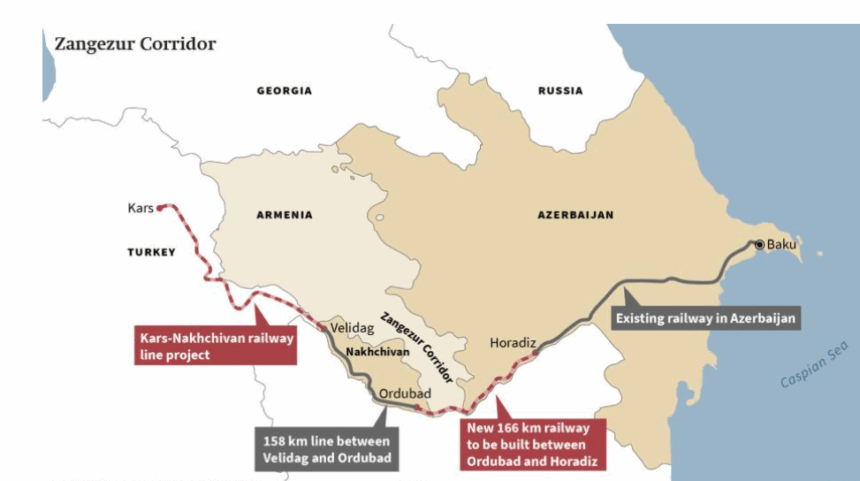
Iran has announced that it has successfully prevented the establishment of the proposed Zangezur Corridor, a planned transport link connecting Azerbaijan to Turkey through Armenia’s southern Syunik province, which Tehran says would have posed serious security risks and undermined its regional position.

In an interview with Tasnim News Agency, Ali Akbar Velayati, senior foreign policy adviser to Supreme Leader Ayatollah Ali Khamenei, warned that the project was a “geopolitical maneuver disguised as a transport initiative,” aimed at weakening Iran and isolating Russia from the south.

Velayati argued that the corridor would have cut Iran’s only land access to Armenia and the Caucasus, thereby disrupting Tehran’s overland connections to Europe. He also claimed, without citing evidence, that U.S. President Joe Biden had acknowledged the corridor’s political momentum and infrastructure readiness.

The proposed route emerged following the 2020 Nagorno-Karabakh war and was referenced in Article 9 of the Russia-brokered ceasefire, which called for unblocking regional transport links. Azerbaijan has since interpreted this as support for a sovereign corridor across Armenia, connecting its mainland to the Nakhchivan exclave. Armenia, however, has firmly rejected this interpretation, insisting all transit must remain under Armenian jurisdiction.

Iran has repeatedly opposed the corridor, warning it would sever its strategic connection to Armenia and increase Turkish-Azerbaijani influence near its borders, especially in areas populated by Iran’s ethnic Azerbaijani minority.

Turkey continues to support the project. During a 2023 summit in Nakhchivan with Azerbaijani President Ilham Aliyev, Turkish President Recep Tayyip Erdoğan emphasized the corridor’s importance for regional connectivity and suggested alternative routes through Iranian territory if Armenia remains uncooperative. The 2021 Shusha Declaration also laid the groundwork for joint strategic infrastructure goals between Turkey and Azerbaijan.

Despite tensions, Iran and Armenia have strengthened energy cooperation. Armenian officials recently announced that a third high-voltage transmission line linking the two countries is 80% complete and expected to become operational in 2026. The line will triple current electricity exchange capacity, reinforcing the bilateral gas-for-electricity swap program.

Iran continues to frame the corridor as a threat to its sovereignty and regional security. Velayati stressed that Tehran’s ongoing presence in the South Caucasus is essential to maintaining regional balance and deterring foreign intervention.

Meanwhile, Azerbaijan and Turkey maintain that the corridor is vital for regional trade and transit. The project’s future remains uncertain, hinging on diplomatic negotiations and the competing interests of regional and global powers.
You Might Also Like

A New Order Without a Vision: The Arab World’s Missing Strategy

Good Cop, Bad Cop: How Trump’s Team Pressures NATO Allies

Vance in the Caucasus: The Maturation of America’s Eurasian Strategy

The Epstein Files and the Chomsky Reckoning on the Left

The Gülen Diaspora and the Return of a Calvinist Moment in Islam

Share This Article
Facebook Twitter Email Print
Previous Article Caught in the Crossfire: Iraq’s Air-Defence Puzzle
Next Article Is Trump’s “Let Them Fight” Strategy Shaping U.S. Policy in the Iran-Israel Crisis?

Stay Connected

TwitterFollow
YoutubeSubscribe

Latest News

Broad Buy-In, Rival Readings, Future Risks: SDF and Damascus Clash Over Integration Terms
Commentary Geopolitics Middle East & Africa
İbrahim Kalın: Erdoğan’s Most Geopolitically Credible Successor
Commentary Eurasia Geopolitics Middle East & Africa
Jeffrey’s Autonomy Model for Syria Matches NAT’s Earlier Proposal
Commentary Geopolitics Middle East & Africa
Strategic and Ideological Missteps of Syria’s SDF
Commentary Geopolitics Middle East & Africa

Find Us on Socials

© GeoPolist. All Rights Reserved.
  • Submit an Op-Ed + Risk Advisory
  • Jobs
  • Post Jobs & Ads for Free
Welcome Back!

Sign in to your account

Register Lost your password?